How to Build Authority as a Food Blogger (And Why It's the Key to Sustainable Growth)
Wondering how to build authority as a food blogger? For many bloggers, posting online can feel a lot like shouting into the void, but it doesn’t have to! Building authority comes down to your content strategy, SEO, branding, email marketing, and consistency.
As a food blog writer, I’ve helped countless clients boost their website authority through strategic content ecosystems, research-backed SEO, and consistency. Now, I’m breaking down my top tips to help build authority so you can continue doing what you love and finally see your blog grow.
If you’re like many of the clients that come to me, you’ve got the recipes, the photos, and the passion that makes you stay up until midnight tweaking a lemon tart recipe just to get it right. You’re even posting every week, but your blog still isn’t growing.
I won’t lie. The food blogging space is crowded. There are millions of food blogs out there. With that, social media, and AI, it’s no longer enough to have good recipes. To grow a sustainable, revenue-generating food blog, you need to build authority so that Google trusts you, readers bookmark you, and brands want to work with you.
Luckily, domain authority isn't reserved for bloggers with 10 years and 100k page views under their belts. It's something you can actively build, no matter where you're starting from.
What Does "Authority" Actually Mean for Food Bloggers?
Authority in the food blogging space means two things:
1. Search Authority (SEO Authority): This is how Google perceives your site. The more high-quality, trustworthy, and well-structured your content is, the more Google rewards you with rankings. Higher rankings = more organic traffic = more eyes on your recipes, affiliate links, and offers.
2. Brand Authority: This is how people perceive you. It's the reason someone chooses your chocolate chip cookie recipe over the thousands of others that pop up in a search. It's what makes readers subscribe to your email list, follow you on Instagram, and recommend your blog to a friend.
Both types of authority work together, and the strategies below will help you build both simultaneously.
1. Niche Down (Yes, Even as a Food Blogger)
One of the fastest ways to build authority is to stop trying to be everything to everyone.
"Food blog" is incredibly broad and speaks to no one. "Quick 30-minute dinners for busy moms" or "healthy high-protein comfort food" is specific and appeals to a specific audience or niche.
You’ve probably heard the phrase that if you market to everyone, you market to no one, and it applies to blogs just as it does standard businesses.
Niching down helps:
Google easily categorize your content and rank it for relevant searches
Readers immediately know if your blog is for them
You become the go-to expert in your specific corner of the food world, rather than a generalist competing with every food site on the planet
To determine your niche, ask yourself: Who is my ideal reader? What specific problem am I solving for them? What type of food content do I genuinely love creating most?
Your niche doesn't have to be microscopic. But it should be specific enough that someone landing on your blog immediately thinks, this is exactly what I've been looking for.
2. Create Content That Actually Answers What People Are Searching For
You can write the most beautifully crafted, delicious-sounding recipe post in the world, and it will still collect digital dust if no one can find it. That's where SEO-driven content strategy comes in!
Building authority means creating content around the exact words and phrases your ideal reader is typing into Google, also known as keywords. When your posts match search intent and are structured in a way Google understands, you earn rankings, and rankings earn you traffic on autopilot, 24/7.
To get started, check out my complete SEO checklist for beginners, learn how to optimize your recipes for Google, and discover six food blogging SEO tips that actually move the needle.
In short, to rank on Google:
Do keyword research before you write. Tools like SEMrush, KeySearch, or even Google's autocomplete can show you what people are actually searching for. Look for keywords with decent search volume and lower competition, especially when you're just starting out.
Write posts with a clear structure. Use your keyword in your title, the first 100 words, at least one H2, and your meta description. Structure your posts with headers (H2s and H3s), so they're easy to scan both for readers and search engines.
Answer the full question. Google rewards comprehensive content. If someone searches "how to make sourdough bread," they want more than a recipe. They want tips, troubleshooting, storage instructions, and serving ideas. The more helpful your post is, the longer readers stay on your page, and the more Google sees you as a trustworthy source.
Be consistent. Publishing one post a month won't build authority quickly. Aim for at least 1-2 well-optimized posts per week, especially early on, to signal to Google that your site is active and growing. And if seasonal timing matters for your niche, read Why Seasonal Content Is a Food Blogger's Secret Weapon for how to plan ahead strategically.
3. Build a Strong, Recognizable Brand
Think about the food bloggers you love and follow religiously. What makes them them?
Chances are, it's not just the food. It's their voice, aesthetic, personality, etc. In other words, it’s them and the feeling you get when you're on their site or scrolling their feed. This magnetism leads to brand authority, which is one of the most powerful tools you have as a food blogger!
Here’s how to develop it on your blog and social media:
Develop a consistent voice. Are you warm and encouraging? Funny and a little sarcastic? Calm and science-forward? Pick a tone that feels genuinely like you, and use it everywhere. Write and speak how you would normally talk. Don’t try to force yourself into a box. It will come off as inauthentic, and readers will know.
Create a cohesive visual identity. Your photography style, color palette, fonts, and overall aesthetic should feel like a unified brand. You don't need a designer for this. Even choosing 2-3 consistent colors and a photography style that reflects your niche goes a long way!
Show up as a real person. People connect with people. Gone are the days of perfectly curated feeds. Share your story, your kitchen mishaps, your obsession with a particular ingredient, etc. The more authentic you are, the more loyal your audience becomes and the stronger your connections will be. And loyal audiences share your content, recommend your blog, and buy your products, which compounds your authority over time.
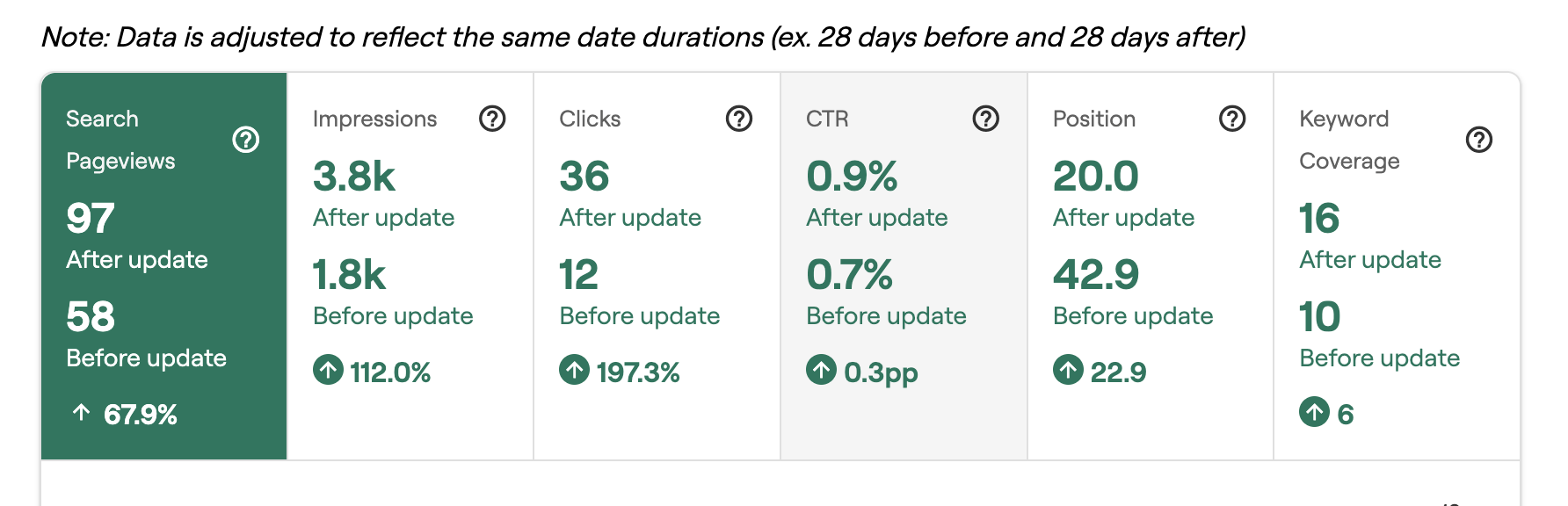
Blog post statistics after making an update.
4. Optimize Your Existing Content (Don't Sleep on This)
If you've been blogging for a while and have a backlog of posts, this step is crucial and often overlooked. Updating old content is one of the fastest ways to build SEO authority because you're working with posts that Google already knows about and has (at least partially) indexed.
By improving the content, you can easily boost the rankings and build on your existing authority all without adding the stress of writing a new post from scratch.
Here's what to look for when determining what and how to optimize blog posts:
Posts ranking on page 2 or 3 of Google: These are your low-hanging fruit. A little optimization, such as adding more detail, updating keywords, improving headers, and adding internal links, can push them to page 1.
Posts with thin content: If a post is fewer than 800-1000 words and doesn't thoroughly cover the topic, bulk it up. Add FAQs, tips, variations, or a troubleshooting section. Look at any comments, and include answers to questions readers are asking!
Posts with broken links or outdated information: Fix them. Outdated, broken content signals to Google that your site isn't being maintained, which is the opposite of what you want.
Posts that are missing meta descriptions or keyword optimization. Go back and add them! My complete SEO checklist walks you through exactly what to audit.
Tip: Set aside time every quarter to audit your existing content.
5. Build Your Email List From Day One
Social media is rented land. Algorithms change, accounts get hacked, and platforms die (RIP, Vine). However, your email list is yours forever.
An email list is one of the most powerful authority-building tools you have as a food blogger because it lets you stay in direct, consistent contact with your most engaged readers. I go deep on this in Why Food Bloggers Need an Email List (Not Just Instagram), but here's the quick version:
Here's how to build and leverage it:
Create a compelling opt-in freebie. Give people a reason to subscribe. A free meal plan, a printable recipe card collection, a "5 meals under 30 minutes" guide. It should be something specific and immediately valuable to your ideal reader. Need help creating one? Check out How to Create a Quick Start Guide (and Grow Your Email List Faster).
Send regular emails. Whether it's weekly or biweekly, consistency is key. Your emails don't have to be long or elaborate. Even a quick "here's what's new on the blog + a tip I'm loving right now" keeps you top of mind and drives traffic back to your site.
Write like you talk. The most effective food blogger emails feel like a note from a friend who happens to be an incredible cook. Don’t try to be or sound like someone you’re not.
Use email to deepen authority. Share behind-the-scenes content, exclusive recipes, lessons you've learned, and your honest opinions on food trends. The more value you deliver consistently, the more your subscribers trust you, and trust is the foundation of authority. For a set-it-and-forget-it approach, learn how to build an evergreen email sequence that nurtures new subscribers on autopilot.
6. Leverage Social Media Strategically (Not Obsessively)
Social media can be a powerful authority-builder, but only when used with intention.
The trap many food bloggers fall into is spending hours every day creating content for platforms that don't drive meaningful traffic or revenue, then burning out before their blog gets a chance to grow.
Instead, think of social media as a traffic driver and brand amplifier, not your primary content strategy.
Choose 1-2 platforms and do them well. Pinterest and Instagram tend to work best for food bloggers. Pinterest in particular can drive significant long-term blog traffic because it functions like a visual search engine. Pins can send traffic for years.
Repurpose your blog content. Don't create original content for every platform from scratch. Turn your blog post into Pinterest pins, Instagram carousels, and Instagram Stories. Work smarter, not harder!
Use social to build community. Respond to comments. Ask questions in your captions. Show your face. Social media builds the human side of your brand that makes people want to come back for more.
7. Earn Backlinks to Boost Your SEO Authority
In the world of SEO, backlinks (other websites linking to your content) are like votes of confidence. The more high-quality sites that link to yours, the more Google trusts your site, which improves your rankings across the board.
Here's how food bloggers can earn backlinks:
Get featured in roundups. Reach out to other bloggers and publications who do "best of" lists (best chocolate cake recipes, best summer salads, etc.) and pitch your posts for inclusion.
Guest post on other food blogs or health websites. Guest posting puts your name and content in front of new audiences and earns you a backlink in the process.
Create genuinely linkable content. Comprehensive guides, original research, unique frameworks, or a truly definitive resource on a topic naturally attract links over time. Think about what would make another blogger or website say, "I need to link to this."
Get listed in directories. Submit your blog to food blogger directories and round-up sites in your niche.
8. Be Consistent
Authority isn't built overnight. It's the result of consistently showing up, creating valuable content, optimizing for search, nurturing your audience, and staying the course even when growth feels slow.
Every post you publish, every email you send, every backlink you earn compounds over time into something powerful. The food bloggers with real, lasting authority didn't go viral once and coast on it. They built sustainable systems and let those systems do the work over time.
To Conclude
Building authority as a food blogger comes down to creating content that genuinely helps people, making sure Google can find it, showing up consistently, and nurturing your audience like the community they are.
It's not about gaming the system or chasing trends. It's about building a blog that earns trust from search engines and real humans over time.
Start with one or two strategies from this list, get consistent, and then layer in the rest. Before you know it, your blog won't just exist. It'll rank, connect, and convert!
Want help creating SEO-optimized blog posts that build authority without adding to your to-do list? Explore my blog writing services.
More Helpful Posts

Shyanne is an SEO writer and content writer from the U.S. Since 2019, Shyanne has worked with countless food bloggers, health professionals, and fitness experts to rank on Google and increase website traffic and drive email conversions.
With an English degree, a minor in nutrition, a minor in history, and a concentration in creative writing, Shyanne loves working with entrepreneurs and brands in the health, wellness, and food spaces.
Not only does she offer done-for-you SEO and blog writing, but she also provides done-for-you email strategies and packages for a comprehensive business plan that allows founders and CEOs to take a step back from social media and focus more on what they love, knowing the right people are finding their brand.