How to Find Blog Topics to Write About
Wondering how to find blog topics to write about? You’re not alone! Having a consistent blogging schedule is crucial for a well-functioning content ecosystem and is one of the easiest ways to boost your rankings and build domain authority.
However, after 8+ years as a blog writer, one of the most common complaints I hear from clients is not knowing what to blog about. So, today, I’m breaking down the top ways I find blog topics to write about both for myself and my blog writing clients.
This post gives you the full system: how to find blog topics, how to know if they're worth writing, and how to turn your ideas into a content plan that builds authority. Whether you're a food blogger, a service-based business, or a brand trying to scale organic traffic, these methods work.

Before You Start: The 3-Question Filter
Not every topic is worth your time. Before you add anything to your content calendar, run it through this quick filter:
Is someone actually searching for it? If there's no search volume, you're writing for an empty room. Use keyword data (more on that below) to confirm real demand exists.
Can you realistically rank for it? A brand-new blog has no business going after "SEO tips" (The term has a keyword difficulty of 85 and is dominated by Moz and HubSpot, meaning it’s nearly impossible to rank for). Filter for keywords with lower competition relative to your domain authority.
Does it align with your niche? Google rewards topical authority. A post that's off-topic for your site hurts more than it helps, even if the keyword looks great in a spreadsheet.
Keep this filter handy as you research. Every idea that makes it through is a topic worth pursuing!
1. Keyword Research
This is my favorite way to do blog content research! I use SEMrush and Ahrefs, but there are other tools like Ubersuggest and Google Keyword Planner.
In SEMrush, you can enter your website’s URL into the search bar and view the terms you’re already ranking for. If you don’t have a specific post targeting your top-ranking keywords, generate a list of new blog post topics using the ranking words to drive even more website traffic for those searches.
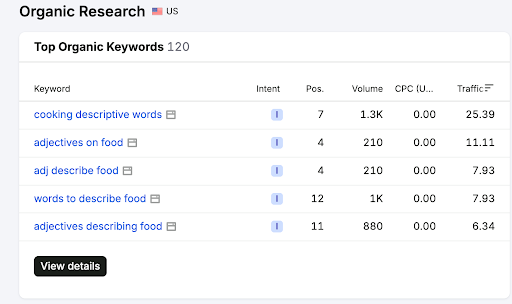
Use SEMrush and similar tools to research organic keywords.
You can also use the keyword magic tool to search terms you might want to write about. SEMrush provides metrics for those terms along with related search terms and phrases that you can include in the post or use to generate additional posts.
As you can see in the screenshot, you can view suggestions, related terms, volume (how many people are searching for a term), and the ranking difficulty, which tells you how hard it will be for your post to rank on Google for a specific term. These stats help generate ideas and filter out which keywords are worth targeting.
2. Audience Feedback
Chances are, if you have a business and blog (of any kind), you have an audience and customers. Listen to what they’re saying! What topics are they discussing with you and their peers? This can give you incredible insight into what’s worth talking (blogging) about.
3. Audience Questions
Along the same vein, pay attention to the questions your audience is asking, whether that’s in person, on social media, or in intake forms. If there are questions you find yourself answering over and over, that’s a fantastic sign to make a blog post. Then, you can just send it over instead of repeating yourself for the millionth time!
4. Social Media
I know, I know, everyone is trying to spend less time on socials, and I’m a huge advocate for it, especially when you have a solid evergreen email sequence. BUT! It can be incredibly useful when used intentionally.
Use hashtags to search topics, follow industry influencers to see what topics they’re discussing, and conduct surveys or polls with your own audience. Instagram stories are a great way to do this!
5. Competitors
I try not to look at my competitors for fear of falling into comparison traps and copying their content subconsciously, but I can’t deny that it’s useful. Don’t copy their content, obviously, but you can use it for inspiration. What topics do they cover that you can talk in-depth about? Are there any posts you’re confident you can outrank them with? Go for it!
6. Online Communities
Online communities and threads like Quora and Reddit can be goldmines when it comes to finding blog topics to write about. People often ask questions and have long conversations about different topics. Start looking up terms related to your niche, and jot down any discussion topics you come across!

Ask questions and type phrases into Quora to see what users are discussing.
7. Personal Experiences
This might be a bit of a hot take, but not every blog topic has to be rooted in solid SEO. You can also (occasionally) use your blog to dig deeper into personal experiences and provide a little more humanness. Share stories, struggles, lessons, successes, etc. that might be helpful or inspiring to your audience. Just don’t make this your only strategy when it comes to finding blog post topics, or it will likely be difficult to rank on search engines.
8. Case Studies
Use your own work. People want to make sure that you’re good at what you do, whatever that is, before they hire you or invest any more time on your site. Keep track of successes with clients or projects, and write case studies showcasing your results.
9. Books
Business books are an excellent place to start looking for blog topics to include on your website. Read books related to your niche, and use them as inspiration for blog topics to write about. You could even write a review of the books as a standalone blog post! Just make sure to always quote the ideas and sources you’re sharing.
10. Podcasts
Similar to using books as podcasts, industry podcasts can spark ideas for new blog posts to write about. And again, you can even review the podcasts or create a list fo your favorite podcasts as a resource for your audience. For example, for my food blog clients, I love the Eat Blog Talk podcast.
11. Webinars
I view webinars through the same lens as podcasts. I usually learn something to discuss with clients and colleagues. And I can cover the topics discussed in more detail, doing my own research for blog posts.
12. The News (Digital or Physical)
Depending on your niche, it can be beneficial to watch teh news on TV or pick up a local newspaper. What topics are being covered? Can you write about them? Or, write a piece on why you disagree with a take!
13. People Also Ask Section of Google
I use this when generating individual blog posts, too! Type a term related to your business into Google, and scroll down to the People Also Ask Section on the first page. Use these topics to create blog posts and even structure your outlines.
14. Hot Topics
What’s going on in your industry? What are people buzzing about? Write about it! For instance, many SEO experts and freelance writers have written pieces about their thoughts on AI. Websites like Google News, Feedly, Yahoo, or specific industry publications can inspire blog topics to write about.
15. Ask AI
Use ChatGPT and similar tools to help generate blog topics to write about. Tell it about the services you provide, your top competitors, and your goals, and ask it to provide topic ideas. You may have to adjust your prompt a few times, but it can help spark some ideas.
16. Use Old Content
Look at well-performing social media posts or any other content you have, and use them to write blog posts. Pro-Tip: Embed YouTube videos and podcasts into your blog posts to boost authority and drive traffic both ways!
16. Use Your Own Expertise
You know your business! Put down the phone and sit down with a paper and pen. I’m confident that you can generate plenty of ideas related to your niche. What did you want to know when you were starting? What areas interest you most? What do you wish clients or customers knew? Make a list, and dig into SEO to narrow it down, using this SEO checklist to rank higher.
How to Turn Blog Post Ideas Into a Content Plan
Finding topics is only half the job. Here's how to go from a list of ideas to an actual publishing calendar:
Step 1: Validate every idea with keyword data like search volume, competition, and intent. If it doesn't pass the 3-question filter above, skip it.
Step 2: Group your topics into clusters. Don't publish topics in isolation. Instead, build a pillar post (broad, comprehensive) supported by satellite posts (specific subtopics). Then, link them to each other. This cluster structure is what tells Google you have real authority on a subject, and it provides genuinely helpful and relevant content to your audience, making you a trusted source.
Step 3: Prioritize by opportunity score. High volume + low competition + high relevance to your niche = publish first. Low volume + high competition = skip for now.
Step 4: Map to a calendar. Aim for consistency over frequency. One well-researched post per week beats five thin posts. Use a content calendar to stay organized if you don't have a system yet.
Step 5: Track and update. Keyword research isn't a one-time task. Check Google Search Console monthly, and update posts that are sliding in rankings. The posts that are already ranking are usually more valuable to maintain than new posts are to create.
Frequently Asked Questions
-
Start with long-tail keywords (longer, more specific phrases with lower competition). A new blog has no domain authority, so targeting broad keywords is a waste of time.
Use keyword tools to find low-difficulty variations (KD under 30 is a good rule of thumb early on), write thorough posts on those, and build from there.
-
Have at least 10-15 validated topics lined out before you publish your first post. This ensures you have enough to build a cluster structure and maintain a consistent publishing schedule without running dry in week three.
-
No. Google Search Console, Google's People Also Ask section, AlsoAsked (free tier), AnswerThePublic (free tier), and Reddit are all free. Paid tools like SEMrush and Ahrefs give you more data faster, but you can do solid research without them, especially early on.
-
Focus on question-based keywords, write comprehensive content that answers the full question (not just the surface-level version), and use clear structure (headers, short paragraphs, direct answers at the top of each section). AI Overviews tend to favor content that's specific, authoritative, and well-organized, which is the same content that ranks well in traditional search.
-
Consistency matters more than frequency. Once a week is a solid target for most bloggers. However, publishing one high-quality, well-researched post per week is significantly better than three thin posts per week. Quality signals like depth, internal linking, E-E-A-T outweigh volume.
There you have it! I hope you found this list helpful. What method are you going to use to find blog topics to write about first? Keep a running list of ideas and use a blog content calendar to keep yourself organized as you research. Happy blogging!
And if you’re looking for help with ideation or blog post writing, I’d love to chat. Check out my blog writing services to see how we might work together.
More Helpful Resources

Hi! I’m Shyanne, the blog writer behind Shyanne Reynolds Copywriting.
I fuse SEO strategy and personality to create human-driven copy that ranks without sounding like a robot.
Curious about working with me?