What Is Domain Authority (And How Do You Actually Build It)?
What is domain authority? Domain authority is a search engine ranking score developed by Moz Domain using various ranking factors to determine the authority of a website, largely based on its backlinks.
In my 8+ years of freelance blog writing, I've developed a few tips and tricks to boost domain authority and have even uncovered common mistakes I see among bloggers trying to boost their authority.
Let's break everything down, covering the definition of domain authority, how to improve it, and what to avoid to boost your website's authority and rank higher on search engines!

What is Domain Authority?
Domain authority, often referred to as DA, is a search engine ranking score developed by Moz. It predicts how likely a website is to rank in search engine results pages (SERPs), ranging from 1 to 100. Higher domain authority tells search engines that a site is more authoritative with a better backlink profile, making it more likely to rank for keywords.
When it comes to authority domain, remember:
It's conditional: Domain authority compares your website against others, meaning it's most useful for tracking your performance within your specific industry.
It's calculated using backlink data: Domain authority is based on data from a variety of factors. However, the quality and quantity of backlinks heavily influence a site's DA.
It fluctuates: Domain authority isn't static. Search engines put out frequent updates, and websites evolve and change. As a result, domain authority often fluctuates. Don't stress about it too much!
Domain Authority vs Page Authority vs Domain Rating
It’s easy to confuse domain authority with other similar SEO metrics. Here’s a simple breakdown:
Domain Authority (DA - Moz): Measures the strength of your entire website
Page Authority (PA - Moz): Measures the ranking strength of a single page
Domain Rating (DR - Ahrefs): Focuses heavily on backlink strength
Authority Score (SEMrush): Combines backlinks, traffic, and spam signals
While these metrics are similar, they are calculated differently and should be used as relative benchmarks, not absolute truth.
Why is Domain Authority Important for SEO?
As mentioned, knowing your website's domain authority allows you to more easily predict its ability to rank in search results and gauge ranking potential against competitors.
For instance, if I'm writing a post for a lasagna recipe, I can look at the keyword difficulty, which shows that it's very hard to rank for in Google. Therefore, I know that a site with a low domain authority will have little to no chance of ranking for that word.

Lasagna recipe has a high search volume and keyword difficulty of 68, meaning it’s extremely difficult to rank for, especially if I have a low domain authority.
So, I target easier keywords, such as vegetable lasagna recipe or lasagna with meat and sauce. Targeting these keywords will not only improve site rankings but will also boost domain authority so that the site can eventually begin targeting more difficult keywords.
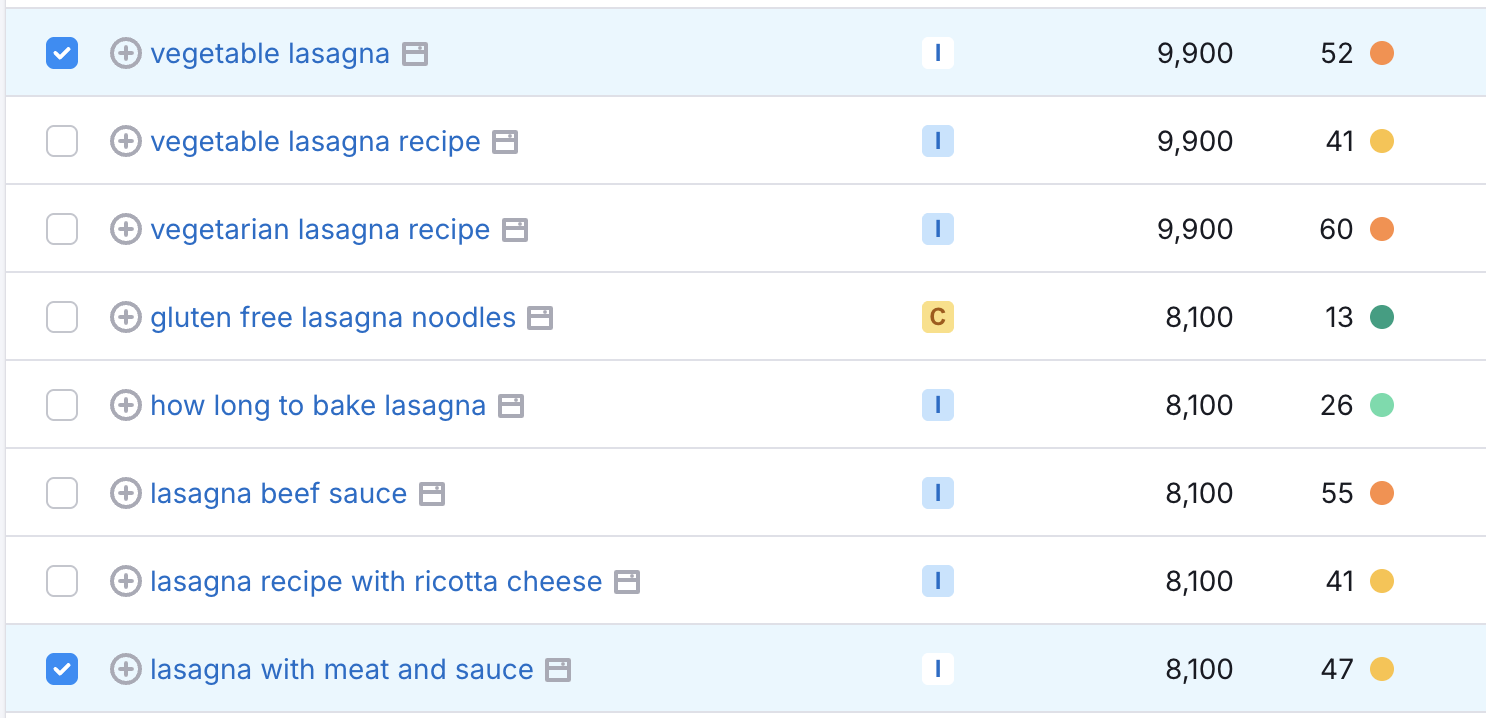
Vegetable lasagna has a keyword difficulty of 52 and lasagna with meat sauce has a keyword difficulty of 47, which are much easier to rank for.
In short, domain authority:
Allows for competitive benchmarking: Knowing your DA allows you to compare your site to other competitors in your industry or niche. If a competitor has a significantly higher DA, you know you'll need better content and a strong link-building strategy to be able to outrank them for any given keyword.
Predicts a site's rank search capability: The higher a site's DA score, the higher the authority SEO and the easier it will be to rank for any given keyword. Put simply, a higher domain authority means your site has established trust in the eyes of search engines (and often readers).
How is Domain Authority Calculated?
It's important to note that, according to an interview conducted by Kristi Hines at Search Engine Journal, it has been confirmed that Google does not factor domain authority into its rankings.
It is a rank search engine created by an outside party. Here’s how Moz Domain Authority is described:
“…the calculation of a domain’s DA score comes from a machine learning algorithm’s predictions about how often Google is using that domain in its search results. If domain A is more likely to appear in a Google SERP than domain B is, then we would expect domain A’s DA to be higher than domain B’s DA.”
The most important factors that determine a site's domain authority include:
Link Profile: The web page's internal and external links. The higher quality links, leading to high-authority or reputable websites, the better your link profile and therefore DA.
Root Domains (Backlinks): When determining a website's rank, Moz looks at the number of unique backlinks. If you have repeated backlinks from the same site, Moz considers it one link. For the best results, put effort into building backlinks across as many high-authority websites as possible. Check out these tips to get better backlinks and build authority SEO.
Spam Score: This is a metric that Moz uses to measure the percentage of sites with similar features to the website in question, used to identify spammy links or websites with thin content, small site size, or low link diversity.
Is Domain Authority a Google Ranking Factor?
No, Google does not use domain authority when ranking content. Instead, it uses its own signals, such as links, content quality, search intent, and E-E-A-T, all of which happen to align with DA rankings. Therefore, by optimizing for DA, you're optimizing for Google and vice versa.
How to Check Domain Authority
You'll need outside tools to check your site's domain authority. Some of my favorites include:
1. Moz Link Explorer
Enter any domain in the explorer, and check its DA score and backlink data, including referring domains and top-linked pages.
This allows you to see exactly where your backlinks are coming from and how strong they are. The free version offers a limited number of searches a month, but I find it's more than enough!
2. MozBar Browser Extension
This extension allows you to see DA scores in your search results, making it easy to compare different pages at a glance. You can also click on a site to see its page authority and link metrics without the need to leave your browser, which comes in particularly handy when conducting research.
3. Free SEO Checker Tools
Some free SEO checker tools display domain authority using Moz data or their own similar calculations.
These reports typically show domain authority, page authority, and basic backlink counts, making them great when you just need a quick overview. Keep in mind that each platform uses a slightly different ranking system. So, the data may differ slightly.
4. SEO Tools and Platforms
Some SEO research tools and platforms, like SEMrush (my go-to for keyword research) and Ahrefs, use similar formulas to Moz to create comparable authority metrics.
Ahrefs uses Domain Rating, which focuses heavily on the strength and quantity of backlinks. Meanwhile, SEMrush uses Authority Score, which blends link data with traffic signals and spam factors, similarly to Moz's domain authority ratings.
Other tools provide similar data, often providing straightforward authority scores, looking at surface-level signals like backlink numbers and quality. They're great for a quick check of a site's DA or a simple comparison, but aren't ideal for in-depth reports.
What is a Good Domain Authority?
Unfortunately, similarly to the question "How long should a blog post be?", there's no concrete answer as to what ranks as a good domain authority. What truly matters is how your site's DA compares to competitors in your niche or industry.
In general, new or small sites typically rank somewhere between 1 and 20, growing to a DA score of 20 to 40 as they grow and gain traction. Scores between 40 and 60 are reserved for well-established sites with lots of backlinks. Scores beyond 60 are difficult to achieve and are only associated with the most well-known brands.
For the best results, I recommend focusing on outranking your top competitors and then improving your DA from there.
How to Increase Domain Authority
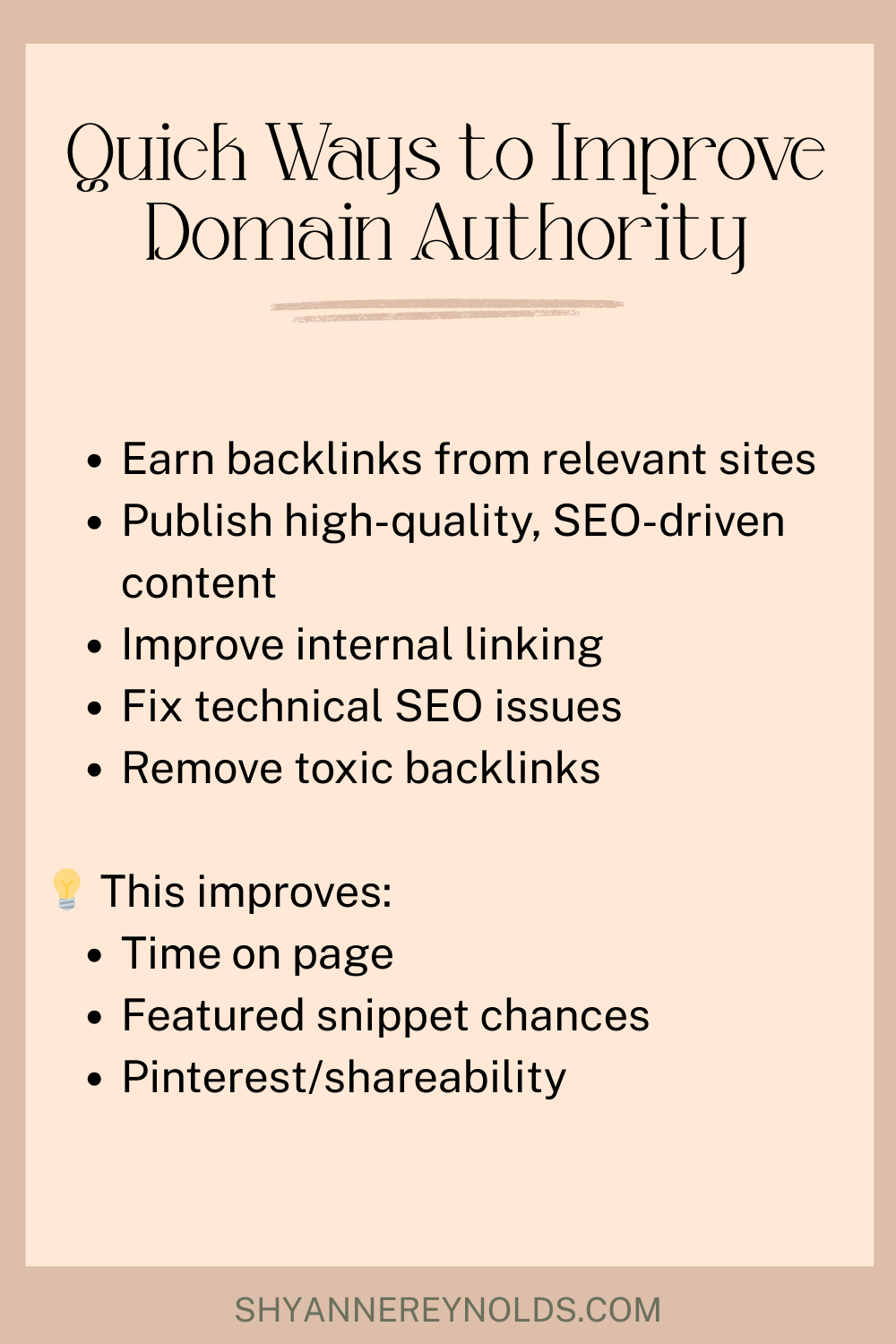
The best way to increase your site's DA is to improve its overall SEO health. I use SEMrush to check this for clients, cleaning up broken links, missing meta descriptions, etc. Then, focus on driving high-quality external links pointing people to your site from other sources (backlinks).
Here are some of my tried and tested ways to improve a site's domain authority:
Earn High-Quality Backlinks
To naturally attract backlinks, create helpful, link-worthy content, such as original research, expert guides, and shareable resources that will be helpful to other audiences.
Remove Toxic Backlinks
Use tools like Moz's link explorer to regularly audit your site's link profile and identifya nd remove spammy or harmful links. Remember, not all backlinks are good! Links from shady sites can actually hurt your own, no matter how good the content may be.
Optimize SEO
Make sure to follow best practices, targeting one primary keyword and several secondary keywords, incorporating E-E-A-T, meeting search intent, and optimizing all your blog posts accordingly. The better your on-page SEO, the more likely your blog posts are to show up on Google and the more likely they are to be linked in outside resources.
Improve User Experience
Admittedly, this is not my area of expertise, but the basics are simple! Make sure your site is fast and mobile-friendly with intuitive navigation that makes it easy for users to find what they need. This encourages people to stay longer and engage with your content, which boosts your authority rankings.
Focus on Implementing a Strong Internal Linking Strategy
Use internal links with strong anchor texts in your content to naturally guide users to relevant content within a post, leading to link equity across your site. A clear and well-structured linking strategy improves your site's crawlability and enhances user engagement, keeping them on your site and likely to come back later.
Create high-quality content
This is the golden rule of anything SEO-related and should be prioritized over all else. Publishing valuable content that answers reader questions and solves problems is more likely to rank on search engines and keep reader attention, organically driving higher rankings, a more engaged audience, and a higher domain authority.
Mistakes to Avoid
When people start asking, "What is domain authority?", they typically begin to grasp at straws to improve their site. This is unnecessary and often leads to common mistakes, such as:
Buying Backlinks
This can harm your site's credibility and lead to penalties within search engines, ultimately hurting your DA. Focusing on earning high-quality backlinks organically instead.
Over-Optimizing
Avoid outdated keyword stuffing or SEO techniques. These are not only no longer effective for ranking but also reduce the user experience and damage your site's reputation and therefore authority.
Failing to Upkeep Technical SEO
Make sure to monitor your site frequently to prevent a slow or outdated site. Make sure it's mobile-friendly, technical errors are fixed, and everything is easy to navigate.
What is Domain Authority FAQs
-
Domain authority increases as your website builds trust and credibility over time. This typically happens when you earn high-quality backlinks from reputable sites, consistently publish valuable, well-optimized content, and maintain strong technical SEO (like site speed, mobile-friendliness, and proper site structure).
-
No one directly “manages” your domain authority. It’s a metric created by SEO tools like Moz to estimate how likely your site is to rank in search engines.
That said, you influence it through your SEO strategy with factors like high-quality content creation, link building, and overall site optimization all playing a role.
-
A high domain authority score means your website is seen as more trustworthy and authoritative compared to others. This usually translates to a better ability to rank in search results, especially for competitive keywords.
However, domain authority is relative. A “high” score depends on your niche. For example, a DA of 40 might be strong in a smaller niche but low in a highly competitive space like food blogging.
-
A drop in domain authority can happen for a few reasons, and it’s not always a bad sign. Common causes include:
Loss of backlinks (sites removing or updating links)
Competitors gaining stronger backlinks faster than you
Updates to the scoring algorithm (especially from tools like Moz)
A slowdown in content publishing or SEO efforts
It’s important to remember that domain authority is a third-party metric, not a direct ranking factor. Focus on building high-quality content and backlinks, and your score will follow!
-
Domain authority ranking falls in line with typical SEO rankings, taking anywhere from 6-12 months to take effect. New sites typically require 3-6 months to see any kind of movement. Medium and large, or established sites, see slower gains, typically taking 6-12 months to show improvements.
Keep in mind that plateaus are normal! Focus on continuing to upkeep your site and publish high-quality content that serves your audience, and the rest will fall into place.
In Conclusion
The answer to "What is domain authority?" is that, generally speaking, it's a way of ranking a website's credibility through factors like backlinks and SEO. Originally developed by Moz, it can make it easier to perform keyword research and create content plans to outrank competitors.
That said, domain authority varies from site to site and often fluctuates due to competitor changes and shifting algorithms. The best way to boost a site's domain authority is to focus on keeping technical SEO in tip-top shape, utilizing an internal linking strategy, and publishing regular, high-quality content.
No time to research and publish yourself? That's where I come in! Explore my blog writing services to see how I can help you upkeep your blog with high-quality, SEO-optimized posts that rank in search engines and boost your site's authority.
More Helpful Resources

Hi! I’m Shyanne.
I’ve been a content writer for 8 years now. I fell into this filed by accident after applying to a VA position from a nutritionist while in college.
Fast forward a few years later, and I had an English degree with a concentration in Creative Writing and minors in History and Nutrition, and a fledgling business.
Now, I help food bloggers, fitness experts, and health professionals with done-for-you blog writing and done-for-you email writing services!
Growing up, I always loved food and cooking, and writing was my first passion. Later, I discovered fitness and nutrition, and pursued personal training before really leaning into my writing career. Now, getting to marry all of my passions while helping others achieve their own goals truly feels like a dream.
I love all aspects of writing and am trained in SEO and copywriting. If you’re interested in hiring a content writer to handle your needs, I promise you’ll be in good hands!

Hey there — I’m Shyanne
Your new go-to SEO specialist and content writer for all things blogging and email.
If you’re a food blogger, fitness expert, or health professional who landed on this page, chances are you’re crazy good at what you do. But copy? SEO?
Not your thing.
Through research-backed SEO, content mapping, and human-driven copy, I help creators and entrepreneurs drive traffic to their brand and build deeper connections to foster community and boost sales — without the need to show up on socials every damn day.
If you’re ready to take your copy strategy to the next level, I’m ready to help!