How Many Keywords Should I Use for SEO? (A Complete Guide!)
Keywords, or the terms people search for online, are crucial for successful blogging, helping your website and posts show up on Google and in AI search. But how many keywords should I use for SEO? I get this question from clients a lot! You should use one primary keyword at least a few times per page along with a few secondary keywords, woven naturally into your content.
According to Ahrefs, nearly 70% of online experiences begin with a search intent. This means that users are actively opening the internet, searching for a specific keyword or phrase, and Google shows information to answer their search intent or query.
Using SEO keywords appropriately is how your website lands on the SERPs (search engine results pages), allowing your content to be found and your business to reach more people. In this post, I’ll break down how many keywords to use for SEO and where to use them to help your content show up on Google and in AI to drive more clicks, leads, and sales.

What are SEO Keywords (And Why Are They Important)?
SEO keywords are search queries (specific words and/or phrases) that people search for on Google or other search engines, along with AI tools like ChatGPT, Claud, and Perplexity.
By writing with keywords in mind, you can optimize your blog posts to appear in relevant search results, helping both traditional and AI language models pull from and display your content to users actively searching for it.
Traditional search engines, like Google, use keywords to match queries with relevant pages. However, AI tools read your content and use the information to answer people’s questions and link back to your site. As a result, SEO keyword strategy has changed over the years.
Gone are the days when keyword stuffing is beneficial. Instead, it’s now crucial to include SEO keywords naturally within content, covering topics clearly and thoroughly, providing value for both real-life users and AI engines.
When used properly, SEO keyword usage helps you:
Rank on Google and other search engines: Keywords remain essential for search engine algorithms, giving them insight into what your post is about.
Get cited by AI tools: Clear, well-structured content helps large language models understand and reference your content in queries related to your primary and secondary SEO keywords.
Reach your target audience: By using keywords effectively, your content is more likely to be shown to users actively seeking out relevant topics across search engines.
Boost organic traffic: The higher your content ranks on Google and the more often it is referenced in AI sources, the more traffic you will see being driven to your website and blog.
Increase conversions: By understanding how to rank for relevant keywords, you’ll be able to put your content in front of users actively searching for it, building E-E-A-T and positioning yourself as an expert with readers who are more likely to convert and buy.
How Many Keywords Should I Use for SEO?
Well-structured blog posts should target one primary keyword along with up to five related keywords, also known as secondary keywords. For blog articles, use keyword research tools to choose one main keyword that represents what the article is about.
For example, a blog post’s primary keyword might be “gluten-free pancakes,” delivering a broad, relevant term that’s related to the post and the website’s niche. Then, secondary keywords might include “gluten-free pancakes recipe,” “gluten-free pancakes with bananas,” and “best gluten-free pancake recipe,” giving search tools even more insight into what to expect.
Incorporating all of these keywords not only helps your post rank for the main topic but also captures related search queries, delivering the same page for different searches.
How to Find the Right Keywords
Finding SEO keywords isn't a guessing game. If you want your posts to rank on search engines, you need to utilize data to know what people are searching for, how competitive the terms are, and whether you have a chance of ranking. This is called keyword research.
I use tools like SEMrush and Keysearch to determine search volume and difficulty scores to narrow down primary keywords and then find relevant secondary keywords.
What Are Primary Keywords (& How to Find Them)
Your primary keyword is the single main topic of your page. In other words, it’s the term you most want to rank for. Think of it as the spine of your content. Everything else you write supports it.
Here's how to choose a primary keyword you can actually rank for:
Check search volume: Aim for keywords with at least 100-1,000 monthly searches. Too low means barely anyone is looking for it; too high means you're likely competing with massive domain-authority sites.
Look at keyword difficulty (KD): Most tools score this from 0-100. As a new or mid-level blogger, target keywords with a KD of 30 or below. If your domain authority is low (under 30), aim even lower. A KD of 0-20 is your sweet spot.
Match the search intent: Search the keyword in Google before committing to it. Are the top results blog posts? Product pages? Videos? Your content type needs to match what Google is already rewarding for that query.
Consider long-tail keywords: Instead of targeting "SEO tips" (extremely competitive), go for "SEO tips for new bloggers" (much more specific and winnable). Long-tail keywords are longer, more specific phrases with lower competition, and they often convert better because the searcher knows exactly what they want.
Pro Tip: One of the biggest mistakes I see new bloggers make is targeting keywords that huge authority sites dominate. Before committing to a primary keyword, Google it and look at page one. If the results are all from Forbes, Healthline, or Wikipedia, that keyword is not for you right now. Find a more specific version you can actually win.
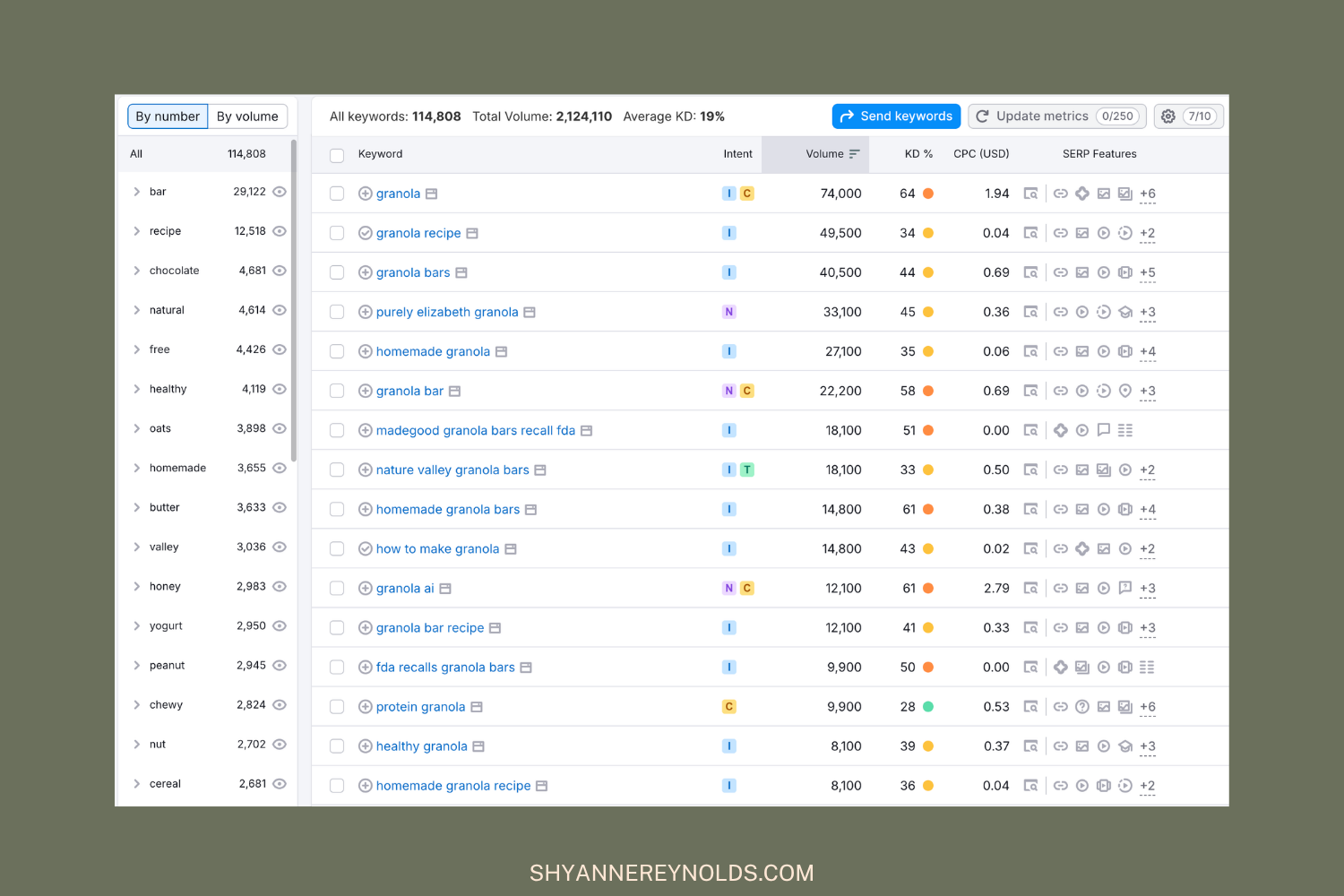
Type a general term into your research tool of choice, and use factors like search volume and keyword difficulty to determine your primary keyword.
What Are Secondary Keywords (& How to Find Them)
Secondary keywords are closely related terms that support your primary keyword. Think of them as the subtopics or chapter headings that help you cover your main topic in full. They're not just synonyms, though. They're the natural questions and angles your reader has around your main topic.
Secondary keywords serve two purposes:
They help your post rank for additional related searches.
They make your content more thorough, which signals quality to both Google and AI tools.
To find secondary keywords, run your primary keyword through your research tool of choice and look for closely related phrases. In Keysearch or SEMrush, you'll see a list of related keywords. Look for ones that share the same general intent as your primary keyword. You'll also want to check the "Questions" tab, which shows what people are actually asking about your topic. Those questions often become your H2 and H3 headers.
Aim for 3-5 secondary keywords per post and work them naturally into your headings and body content. Don't force them.
Why One Primary Keyword Per Page Is the Rule
You might be wondering why not just target several keywords and cast a wider net? When you try to rank for multiple unrelated keywords on one page, you dilute your content's focus. Google exists to give users the single most relevant result for their search. If your page is trying to be about two or three different things, it's a weaker answer to any one of them.
Search intent is the key concept here. For example, a reader who searches "how many keywords should I use for SEO" wants a clear, direct answer. A reader who searches "best keyword research tools" wants a product comparison. Even if those topics are related, they represent different intents, and a single page can't satisfy both as well as two dedicated pages could.
Think of it this way: one well-focused page beats one scattered page every time.
A Note on Keyword Clustering
When you write a thorough, well-structured post targeting one primary keyword, you'll naturally rank for dozens of related terms without even trying. This is called keyword clustering, and it's how advanced SEO practitioners think about content.
For example, if you write a complete guide on "how many keywords should I use for SEO," Google will also start ranking that same post for terms like "how many keywords per page," "keyword density for blog posts," "how often to use keywords in content," and more, all without you having to create separate posts for each one.
This should serve as your permission slip to stop trying to force five different keywords into a single post. Instead, focus on covering one topic thoroughly. The rankings will follow naturally!
How to Use SEO Keywords
Now that you have your keywords, it’s time ot put them to use! In the past, many experts would recommend stuffing keywords into your copy as often as possible, but this advice is outdated and will actually hurt your ranking potential.
Now, it’s best to use your keywords naturally within your copy, focusing more on answering readers’ questions and providing helpful information. For the best results, infuse your primary keyword in the:
Meta title
Meta description
Headers (H2s and H3s where it makes sense)
Blog introduction (as early as possible)
Throughout the main content, where it flows naturally
Conclusion
How Often Should You Use Your Primary Keyword?
Just like there’s no exact answer for how long a blog post should be for SEO, there’s no magic number for how often you should use your primary keyword. However, a general rule of thumb is to use your primary keyword 5-10 times for a 1,000-word blog post. This includes using it in your titles, headers, body content, image alt text, and meta description.
That said, don’t force your keywords. Some flow more naturally than others. So, if infusing a keyword into a specific place is going to make your copy flow oddly, it’s okay to rework it. Just make sure to use your primary keyword at least 2-3 times on the page and then focus on answering the relevant queries.
A useful benchmark: most SEOs aim for a keyword density (keyword count divided by total word count) of under 2%. Anything above that starts to feel repetitive to readers, and Google notices, too.
Real-world example: A 1,500-word blog post with a keyword density of 1% uses your primary keyword about 15 times. That's actually on the high end. Many top-ranking posts use their exact primary keyword far less, relying on natural language and related terms to fill the gaps. Quality and coverage matter far more than hitting a specific number.
What About Keywords for AI Search?
As mentioned, SEO keyword strategy isn't just about ranking on Google anymore. AI tools like ChatGPT, Claude, and Perplexity are now answering search queries directly, and they pull from content that is clear, authoritative, and well-structured.
To get your content cited by AI tools, focus on:
Answering questions directly and concisely. AI models love content that gives a clear answer early, then expands with context. Use your primary keyword in that first clear answer.
Using structured headers. H2s and H3s act like a table of contents for AI. They help the model understand your content's structure and pull the most relevant section for a user's query.
Covering your topic thoroughly. AI models favor content that addresses a topic comprehensively. Your secondary keywords naturally help with this. Each one you address adds depth.
Building E-E-A-T signals. Experience, Expertise, Authoritativeness, and Trustworthiness matter for AI citation just as much as they do for Google. Write from real experience, cite credible sources, and keep your content accurate and up-to-date.
In short, the keyword strategy that works for Google is largely the same one that gets you cited in AI. Write helpful, well-structured content that answers real questions, and use your keywords to guide the topic, not to game the algorithm.
Keyword Research Tools: SEMrush vs. Keysearch vs. Ahrefs
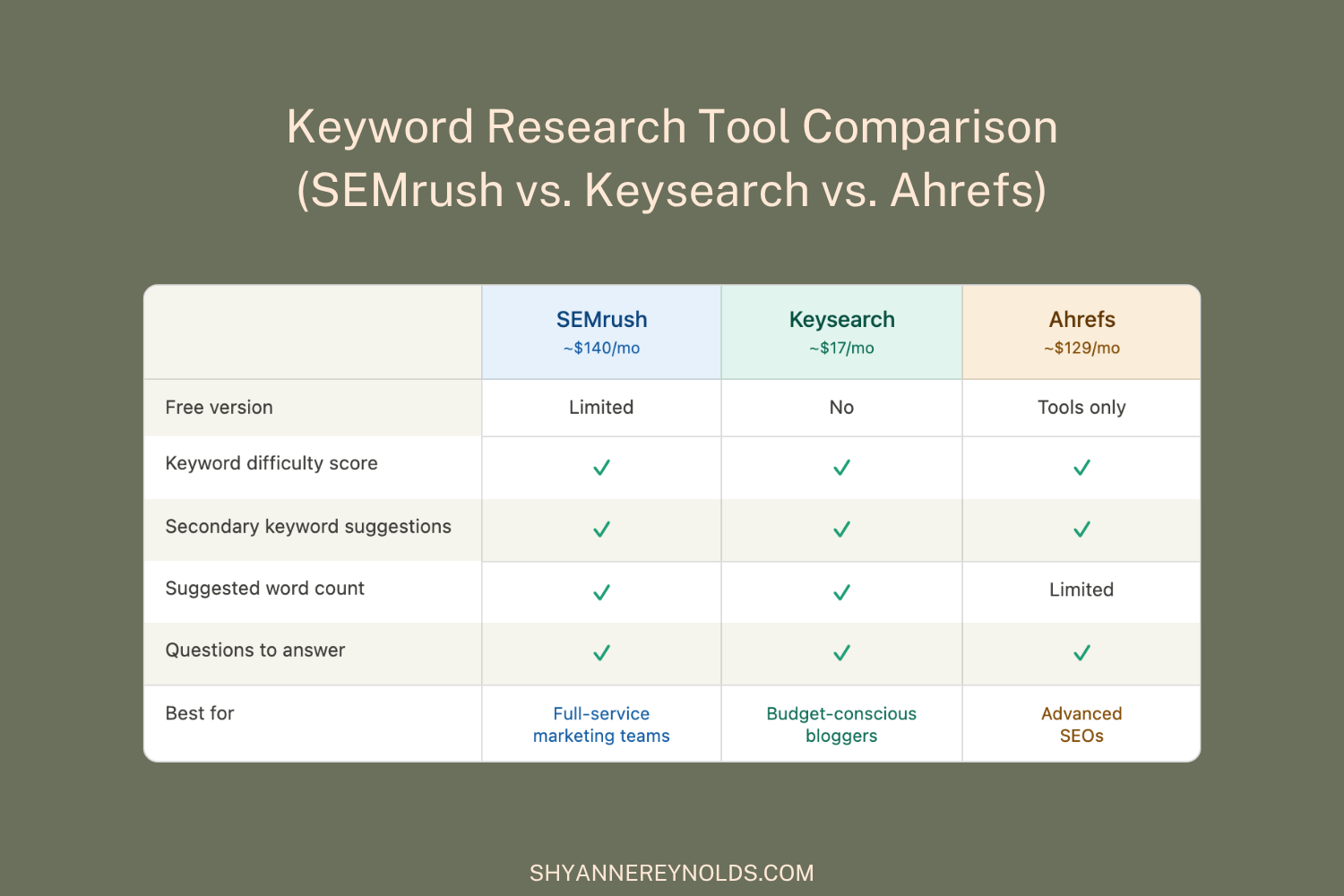
The right keyword research tool makes a significant difference in how efficiently you can find keywords you can actually rank for. Here's a quick comparison of the three tools I recommend most:
How Many Keywords Should I Use for SEO? FAQs
-
This is up to personal preference, but I prefer SEMrush and Keysearch. Both are user-friendly and share all the relevant information you need in an easy-to-understand format.
SEMrush has a free version with a Keyword Magic Tool that is helpful for beginners. The paid subscription offers in-depth information, more keyword insights, and helpful SEO optimization tools.
Keysearch tends to be more budget-friendly and has many of the same features, like secondary keyword suggestions, suggested word counts, and questions to answer within your content.
I recommend experimenting with both to find which you like best.
-
Yes, overusing your primary keyword is considered keyword stuffing and can harm your SEO results. To avoid this, write with your audience (not algorithms) in mind, use your primary keyword naturally within your content, and add secondary keywords where they fit. The most important factor for SEO is to provide value and unique insights for your audience.
-
Long-tail keywords are longer, more specific search phrases, usually three or more words, that tend to have lower search volume but also lower competition. For example, "SEO tips" is a short-tail keyword; "SEO tips for new food bloggers" is a long-tail version.
Long-tail keywords are especially valuable for new bloggers because they're much more winnable. They also tend to attract searchers who know exactly what they want, which often translates to higher engagement and conversion rates.
-
The four main keyword types include informational, commercial, transactional, and navigational. Each represents a different stage in the customer journey.
Informational keywords: Searching for information (how to make granola)
Commercial keywords: Researching products or brands (healthy granola brands)
Transactional keywords: Ready to buy (pre-made granola near me)
Navigational keywords: Looking for a specific website (Purely Elizabeth granola)
Understanding the search intent behind a keyword helps you create the right content and avoid targeting words that don't match search intent, which will lead to higher bounce rates. Taking granola as an example, it would make more sense to try to rank for "granola recipe" rather than "pre-made granola."
-
The 80/20 rule in SEO, or Pareto Principle, states that approximately 80% of a website's traffic or conversions come from 20% of its content, keywords, or backlinks. Focusing on this high-impact 20%, such as updating top-performing pages and securing quality links, dramatically increases efficiency, allowing for higher rankings with less effort.
-
For Google, keywords help the algorithm understand what your page is about so it can match your content to search queries. For AI tools like Claude and ChatGPT, keywords still matter, but the bigger factor is how clearly and thoroughly your content answers a question.
AI models scan your structure, headings, and the directness of your answers. Content that gives a clear answer early, uses organized headers, and covers a topic in full is most likely to be cited in AI responses.
How Many Keywords Should I Use for SEO? Conclusion
Keywords are crucial for search engines and AI tools to understand your content and deliver it to the right audience. When you use keywords strategically, including them naturally throughout helpful content, you’ll rank better, reach more people, and turn visitors into customers and lifelong fans.
Need help with your SEO strategy or blog writing? Explore my services, or contact me. I’d love to help your posts rank through SEO!
More Helpful Resources

Shyanne is an SEO writer and content writer from the U.S. Since 2019, Shyanne has worked with countless food bloggers, health professionals, and fitness experts to rank on Google and increase website traffic and drive email conversions.
With an English degree, a minor in nutrition, a minor in history, and a concentration in creative writing, Shyanne loves working with entrepreneurs and brands in the health, wellness, and food spaces.
Not only does she offer done-for-you SEO and blog writing, but she also provides done-for-you email strategies and packages for a comprehensive business plan that allows founders and CEOs to take a step back from social media and focus more on what they love, knowing the right people are finding their brand.