How Long Should a Blog Post Be for SEO? (Tips & Examples to Optimize Your Content!)
If you’ve been blogging for any length of time, you probably already know the importance of SEO, E-E-A-T, and search intent, but you may be wondering, “How long should a blog post be for SEO?”
After writing hundreds of blog posts, I can honestly say that they all vary in length. So, the short answer is that it depends. Luckily, there’s an easy way to determine how long your posts should be to boost SEO and deliver helpful content. I’ll break down how to determine the length of a blog post and why it’s important.

Does Blog Post Length Actually Matter?
Yes, but probably not in the way you may think. Google does not rank content based on the word count alone. Instead, it prioritizes content that is helpful, comprehensive, relevant to each intent, and easy to read and navigate.
Basically, a high-ranking post is helpful, informative, and precise. These qualifications should determine the length of the post.
For example, if you’re writing about the types of olive oil and how to use them, your blog post will likely be fairly long. On the other hand, if you’re writing about a 5-minute tuna salad recipe, you probably don’t need to include a whole lot of info.
That said, multiple industry studies have found that longer content tends to rank higher, because it naturally covers topics in greater depth.
For example:
Backlinko analyzed 11.8 million Google search results and found the average first-page result contains ~1,400-1,800 words.
Longer content earns more backlinks and shares.
In-depth posts increase time on page and engagement signals.
Taking this into consideration, a standard blog post should typically be around 1,000 words. In 2023, the average length of a blog post was 1,427 words. That said, if a concise post of roughly 800 words is enough to take a deep dive into a topic without providing “fluff,” it’s better to keep it short rather than stuff a page with irrelevant content.
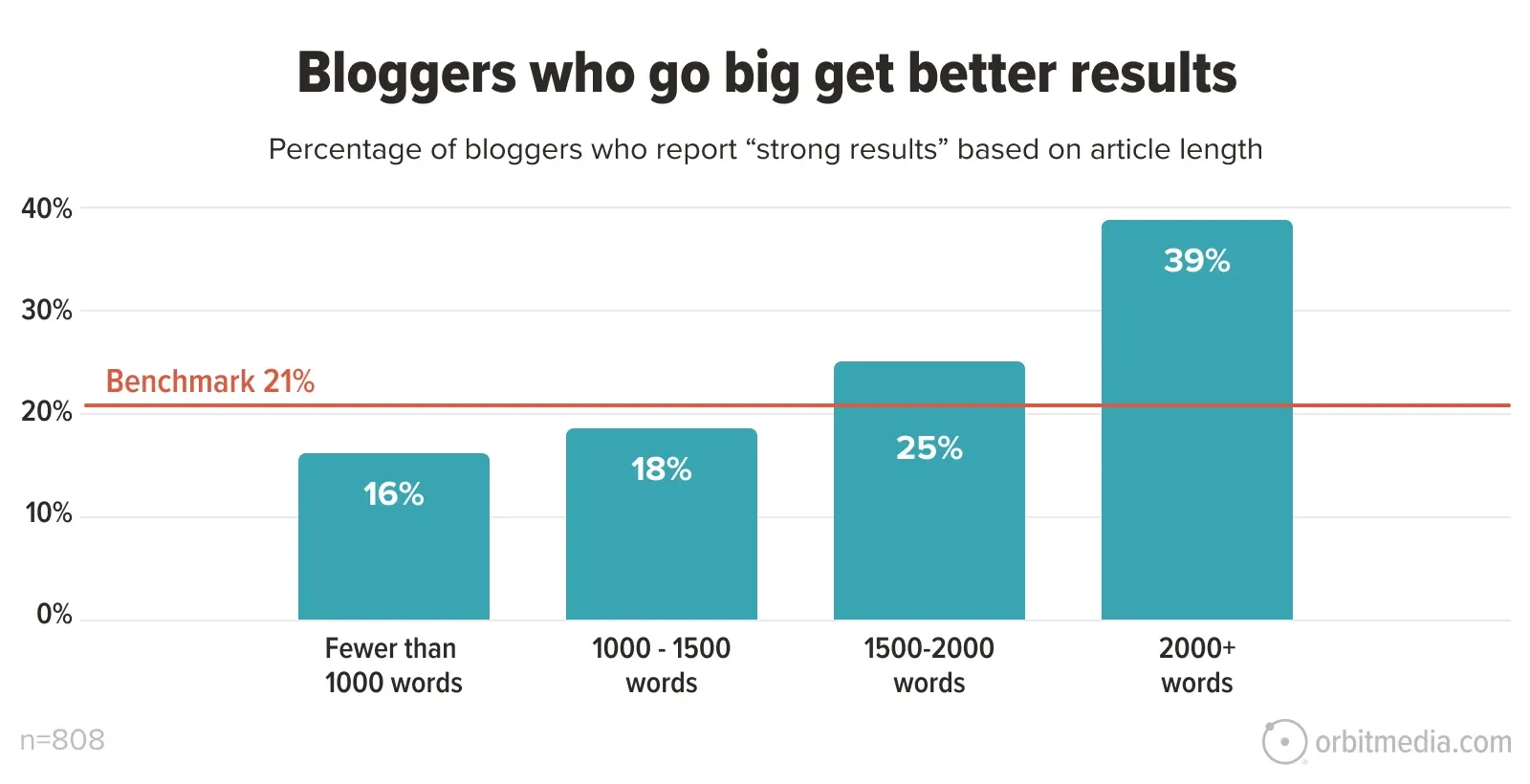
To put this into perspective, I have a client who is a nutritionist who does a deep dive on ingredients, providing science-backed information for her audience. These posts can be upwards of 2,000 words, and they still rank well on Google, because all of the content is actually helpful. Meanwhile, another client does product reviews that fall closer to the 800-word mark, because readers are on the page for a quick transaction.
Short Blog Posts vs. Long Blog Posts
In the blogging world, articles are often referred to as short-form or long-form, but what’s the difference?
Short-Form Articles
Short-form articles fall somewhere between a few hundred and up to 1,000 words. They’re best for quick content like product overviews and special announcements, and often aren’t meant to be evergreen posts.
Short articles are less common and don’t often rank highly on Google (though they definitely can), and as a result, don’t often increase blog traffic. As a result, most short-form posts are written for an engaged audience and are best promoted via social media or email marketing.
Long-Form Articles
A long-form article, on the other hand, is usually upwards of 1,000+ words and shares in-depth information about a specific topic. These are more common and are great for how-to guides, itineraries, listicles, and deep dives.
Many people dread writing long-form blog posts, which is where I come in with blog writing offers to take it off their plate. However, there is an easy way to ensure that short attention spans stay engaged and your audience connects with your content.
When writing long-form articles:
Include relevant, helpful information (Skip the fluff)
Use short sentences and frequent paragraph breaks (Make the content easy to skim.)
Include headers and subheaders
Add relevant graphics
Then, make sure to encourage readers to take action at the end of the post by commenting, sharing, or saving your content. If readers stay on the page and engage, you’ll build trust with Google and start to see much better rankings.
How to Determine Your Ideal Blog Post Length
Given that there is no set word count for how long a blog post should be for SEO, it’s important to determine the proper word count for each individual article. To do this, identify a primary keyword, analyze top-ranking articles, understand your audience and what they’ll want, and focus on providing high-quality information.
Let’s break it down!
1. Identify a Primary Keyword
Use your keyword search tool of choice. I use SEMRUsh, but KeySearch is another great option. Look up phrases related to your topic, and use the following factors to determine a target keyword:
Search volume: This indicates how many people are searching for that term.
Keyword difficulty: This indicates how difficult it will be to rank or show up at the top of a Google search for your chosen keyword.
Related keyword variations: Include these naturally within your post to help boost your ranking.
Questions people are asking: Including this can help you rank for your target keyword and will improve overall reader experience, ultimately boosting your post’s ranking.

Keep in mind that if your target keyword is competitive, you’ll likely need a more comprehensive post to be able to compete with the top-ranking articles. Lower-competition keywords may have a higher chance of ranking well with shorter, more focused content.
2. Analyze the Top-Ranking Articles
Once you’ve chosen your desired keyword, look it up in Google, and study the first page results, looking at the top three to three to five posts ranking for that term. Be sure to pay attention to:
Average word count
Headings and sections included in each post, marking commonalities
Questions answered
Depth of information
Media usage (graphics, examples, videos)
This should give a baseline for what Google considers helpful content, making it easy to outline your post. Remember, your goal shouldn’t be to copy your competitors. Instead, aim to cover all the relevant topics while making your post even more useful and complete.
3. Understand Search Intent
You should be able to determine the search intent for your chosen keyword while you analyze the top-ranking posts. Search intent simply refers to what readers are looking to get out of articles when searching for keywords. It also helps determine how much content is necessary.
For instance, I recently wrote a post about Vietnamese pho. When searching for just pho, links for restaurants come up, indicating that readers who search the term are looking for somewhere to eat. However, when I searched pho recipe, I was given various food blogs, meaning readers intended to make the dish at home.
Search intent not only determines what exactly to write about but also how much content is necessary. A recipe post for pho will have a lot more information than, say, a takeout menu with pho included.
When determining search intent, ask yourself:
Does the reader want a quick answer?
Are readers looking for a detailed guide?
Are readers comparing options or making a decision?
For example:
“What is domain authority?” → brief explanation
“How to build domain authority” → in-depth guide
Matching reader intent ensures your content satisfies readers and ranks well. If a reader stumbles on an article that doesn’t match their intent, they’ll click right off, driving up your bounce rates.
4. Know Your Audience
After you’ve determined a keyword, looked at competitors, and narrowed down the search intent, you should have a solid outline. However, before I begin writing, I always take a second to consider the audience and the stage of awareness they’re in.
Beginners will likely need more context and longer articles with definitions and examples. Intermediate readers typically want practical guidance, and experts prefer concise insights.
When in doubt, write for beginners. Too much information is better than not enough. However, if you know that the readers of your article are seasoned pros or will likely be coming from longer, more informative posts on your site thanks to interlinking, you may be better off with a shorter post.
5. Focus on Quality and Completeness
After writing, I actually don’t recommend using a word counter. Instead of aiming for a specific number, ask:
Does this fully answer the reader’s question?
Are there related questions I should include?
Is the content clear and easy to skim?
Have I removed unnecessary filler?
If the answer is yes and you’re happy with your work, the post length will take care of itself. It’s always best to write for your audience first and Google second.
Tips for Increasing Word Count
That said, if all the top-ranking posts are fairly long and yours is short, it’s likely a sign that you need to increase your word count.
If you’ve ever tried to stretch a post just to hit a certain word count, you already know it can make content feel repetitive and exhausting to read. Instead of adding filler, focus on adding value.
Here are a few ways to naturally increase length while improving quality:
Answer related questions. Look at the “People Also Ask” section in Google and address common follow-ups.
Add examples. Real-world scenarios make your content more helpful and easier to understand.
Include step-by-step instructions. Breaking processes into clear steps adds depth and usability.
Expand beginner explanations. Define terms and provide context for readers new to the topic.
Add FAQs. This improves SEO while ensuring you cover related search queries.
Provide tools and resources. Link to helpful guides, templates, or supporting articles. This can also be a great way to boost your income if you have helpful resources!
Include visuals. Screenshots, charts, or graphics improve clarity and time on page.
The goal isn’t to just make the post longer. It’s to make it more complete.
FAQs
-
Most SEO-focused blog posts perform best between 1,000 and 2,500 words, depending on competition and topic depth.
-
Yes, if the topic requires a quick answer and fully satisfies search intent.
-
Pillar content is typically 2,000-4,000+ words and is designed to be a complete resource.
-
Excessive length without structure can hurt readability. Use headings, bullets, and spacing to keep content easy to scan.
How Long Should a Blog Post Be for SEO Conclusion
The ideal blog post length ultimately depends on your readers and topic. However, at least 1,000 words is usually best. That said, the most important components in writing blog posts that rank are providing helpful and relevant content, covering a topic completely without unnecessary information.
I hope you found this article helpful! For support with your blog, explore my blog writing offers, or contact me to chat or ask any questions. My blog writing services can help you show up on Google, get more traffic, and increase conversions without adding more work to your plate!
More Helpful Resources

Hi! I’m Shyanne.
I’ve been a content writer for 8 years now. I fell into this filed by accident after applying to a VA position from a nutritionist while in college.
Fast forward a few years later, and I had an English degree with a concentration in Creative Writing and minors in History and Nutrition, and a fledgling business.
Now, I help food bloggers, fitness experts, and health professionals with done-for-you blog writing and done-for-you email writing services!
Growing up, I always loved food and cooking, and writing was my first passion. Later, I discovered fitness and nutrition, and pursued personal training before really leaning into my writing career. Now, getting to marry all of my passions while helping others achieve their own goals truly feels like a dream.
I love all aspects of writing and am trained in SEO and copywriting. If you’re interested in hiring a content writer to handle your needs, I promise you’ll be in good hands!

Hey there — I’m Shyanne
Your new go-to SEO specialist and content writer for all things blogging and email.
If you’re a food blogger, fitness expert, or health professional who landed on this page, chances are you’re crazy good at what you do. But copy? SEO?
Not your thing.
Through research-backed SEO, content mapping, and human-driven copy, I help creators and entrepreneurs drive traffic to their brand and build deeper connections to foster community and boost sales — without the need to show up on socials every damn day.
If you’re ready to take your copy strategy to the next level, I’m ready to help!