Why Food Bloggers Need an Email List (Not Just Instagram)
In the 8+ years I’ve been ghostwriting for food bloggers, I see one trend again and again. Most come to me with either a steady blogging routine or an Instagram presence, sometimes both, but they almost always neglect their email list.
I get the reasoning. Blogging brings in revenue through ads, Instagram results in brand deals and income, and you need content before you can start an email list. Pretty soon, email becomes an afterthought.
However, as a copywriter who specializes in email strategy for food bloggers, I’ve seen what a strong email list can do for a content creator’s business. I’m talking sold-out book tours, increasing blog traffic (even when SEO stats dip), and direct sales.
I use email marketing myself, and the results speak for themselves, resulting in higher engagement, more consistent traffic, and a direct line to the people who actually want to hear from me. Most people incorrectly assume that email isn’t important for revenue. However, according to Campaign Monitor, email marketing drives an average of $44 for every $1 spent. That’s a huge ROI that you just don’t get with anything else!
While I know Instagram and other social media platforms can be hugely beneficial, followers aren’t the same as a sustainable email audience, because they’re rented. That means that at any moment, a platform can change the rules, delete your account, and even shut down. Remember when TikTok disappeared or the time Instagram had a blackout?
Many creators were left scrambling, but my email clients continued to operate their business, reaching their audience and making sales thanks to their email lists. This is why building an email list might be the most important business factor for food bloggers who want to build a sustainable, long-term income.
Why an Email List is Crucial for Food Bloggers
Social media is a powerful tool, but it was never designed to be a business foundation. It's designed to keep people scrolling, and that doesn't always work in your favor.
An email list, on the other hand, gives you something no social platform ever can: a direct, unfiltered connection to your most interested readers. No competing content, no algorithm deciding your reach, no 24-hour expiration date on your message. Just you and your audience, exactly the way it should be.
Here's why that matters more than most food bloggers realize.
1. You Own the Relationship
When you post on Instagram, you're borrowing space on someone else's platform. Your followers aren't really yours. They belong to Meta. If Instagram were to disappear tomorrow (or suspend your account, or tank your reach), there's nothing you could do about it.
Your email list is different. Those subscribers chose to hear from you. They gave you their email address, and that contact information is yours to keep, no matter what happens on social media. That means you can pretty much always reach them, and they actually want to hear from you, which isn’t something that’s guaranteed when you’re discovered via a session of doomscrolling.
2. Predictable Income
Creating a strong email funnel allows for consistency, which can be used to create sustainable, long-term income. That kind of predictability is nearly impossible to achieve with social media, where a reel can go viral one day, and a post completely flops the next. That feast-or-famine cycle makes it nearly impossible to plan, grow, or scale your business with any kind of confidence.
But with email? You can create a warm, engaged list full of people eager to open, read, and even buy. When implemented correctly, email provides a predictable way to drive traffic to your blog, promote your offers, and generate revenue on your terms and on your timeline.
3. Not Reliant Upon Algorithms
Algorithm changes are one of the most stressful parts of being a content creator. One update can cut your organic reach in half overnight, and there is nothing you can do about it except adapt and hope for the best.
Email doesn't work that way. When you send an email, it goes to your list. Full stop. There's no algorithm deciding whether your content is worthy of being shown. Your subscribers opted in, and your message shows up in their inbox.
4. A Space for Your Most Engaged Fans
Not everyone who follows you on Instagram is deeply invested in your content. Some are casual scrollers who double-tapped once and forgot about you. And that's fine! But your email list tends to attract a different kind of reader, someone who liked what you had to offer enough to trust you and give them their email address.
Those are your people. They're more likely to click your links, try your recipes, share your content, and ultimately buy from you. Nurturing that segment of your audience through email is one of the highest-ROI things you can do as a food blogger.
5. It Strengthens Your Existing Platforms
In advocating for a strong email list, I’m not telling you to abandon your other platforms. Instead, I’m telling you to use email to strengthen them, making it part of a wider content ecosystem.
When you send an email that links back to your latest blog post, you drive a surge of traffic that signals to Google that your content is worth ranking. When you share a new recipe in your newsletter, your most loyal readers are the first to save it, share it, and comment on it, boosting your visibility on every platform.
Email is the thread that ties your whole content ecosystem together, making everything else work harder and boosting revenue while doing so. Truly, it’s a win-win!
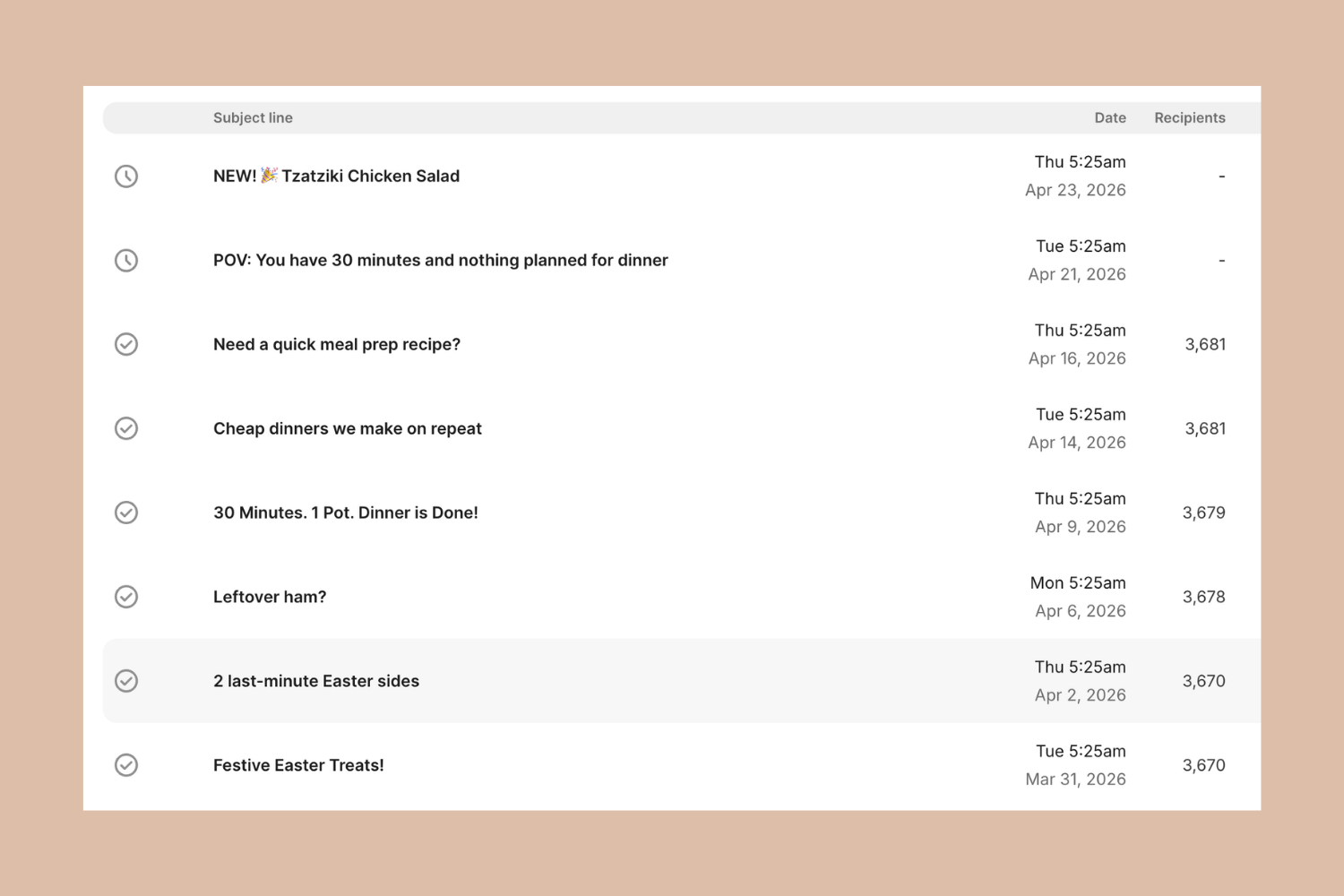
An example of email campaigns sent by a food blogger.
How to Start an Email Newsletter as a Food Blogger
Starting an email list doesn't have to be complicated. Here’s how to get started in about an hour:
1. Choose an email platform. Platforms like Kit (formerly ConvertKit) and Flodesk are popular options for bloggers and are designed with creators in mind. Both offer automation, landing pages, and easy-to-use templates.
2. Create an opt-in incentive. Give people a reason to subscribe. I’m a big fan of utilizing quick start guides, but your opt-in could be a free resource, a recipe roundup, or a meal plan. Anything goes as long as it delivers immediate value to your reader.
3. Set up a welcome sequence. Don't let new subscribers go cold. A simple welcome series introduces you, sets expectations, and starts building the relationship from day one, which creates better open rates and engagement later down the line.
4. Start sending consistently. Whether it's weekly or biweekly, consistency matters more than frequency. Show up regularly, deliver value, and let your list grow over time.
Who Shouldn't Start an Email Newsletter
While I’m clearly a huge proponent of email lists, they aren’t for everyone.
For instance, if you're brand new to blogging and still figuring out your niche, your voice, and what your audience actually wants, jumping into email marketing before you have a clear direction can lead to a lot of wasted effort.
It's worth spending some time getting clear on who you're talking to and what you stand for before you start inviting people into your inbox.
Similarly, if you're not in a position to show up consistently, even once or twice a month, an email list can do more harm than good. Subscribers who signed up and then heard nothing from you for three months are much harder to re-engage than people who never subscribed at all
The good news? If you're not quite ready yet, that's okay. Start with your blog and your content strategy, get some posts published, and build your email list when you have something worth sending people to. Just don’t put it off for too long, or you’ll miss out on a lot of money.
In Conclusion
Building an email list is one of the best long-term investments you can make as a food blogger, but only if your content ecosystem is set up to support it. If you want help creating SEO blog posts that attract the right readers and email sequences that keep them coming back, let's work together!