What Is a Content Ecosystem (And How Do You Build One)?
According to Content Marketing Institute, content marketing generates three times more leads than traditional marketing at a fraction of the cost, but only when all the pieces are working as a connected content ecosystem.
If you're posting consistently on a blog and email list and even have a social presence, but still feel like you're on a content hamster wheel with a lot of effort going in and very little growth coming out, it's likely due to a lack of a content ecosystem.
In other words, your content isn't working together to drive traffic, conversions, and sales. Instead of treating your blog, email list, and social media as separate to-do list items, a content ecosystem connects them to create one strategic system. When implemented correctly, a content ecosystem allows each piece to feed the next, working to grow your audience even when you aren't creating new content.
For food bloggers, health professionals, and fitness experts, especially, building this kind of system is the difference between content that slowly builds a sustainable business and content that just fills a calendar.
In this post, I'll break down exactly what a content ecosystem is, why it matters for your marketing strategy, and how to build one that drives consistent traffic and converts readers into loyal buyers.
What Is a Content Ecosystem?
Put simply, a content ecosystem is a network of content across multiple channels that works to attract, nurture, and convert your ideal audience. For instance, I publish blog posts about SEO, blog writing, and email writing, publish a weekly email, and post on Instagram, driving readers to my email writing and blog writing offers.
The key to a successful content ecosystem is creating pieces across platforms that all work together rather than separately. Each piece you put out on any platform should work to drive readers to another and ultimately reduce your workload while allowing you to publish more often and more consistently.
For example, your blog should drive subscribers to your email list, and your email list should drive readers back to your blog. Then, your social media can be used as a growth tool, bringing new eyes to your ecosystem. When working together, all of your content helps build trust and turn readers into buyers without you having to lift a finger.
When built intentionally, your content stops being a to-do list and starts being an asset. Older blog posts keep driving traffic. Emails keep nurturing subscribers. And your audience keeps growing even on the days you aren't creating anything new.
What Is a Content Ecosystem in Marketing?
In marketing, a content ecosystem is the strategic framework that moves someone through the entire customer journey, from discovering you for the first time all the way to becoming a buyer, without relying on constant launching, paid ads, or being glued to social media 24/7.
Here's what that journey looks like in practice:
A potential client searches Google for a healthy dinner recipe, a beginner workout plan, or tips on growing their food blog.
They land on one of your blog posts, find it helpful, and opt into your email list.
Over the next few weeks, your emails build familiarity and trust.
When you mention your services or a product, they're already warm. They know you, they like your approach, and they trust your expertise. Therefore, they're more likely to buy.
That entire journey happened without a launch, without a paid ad, and without you showing up on Instagram stories every single day. Your content ecosystem guided them through the levels of marketing awareness, from stranger to subscriber to buyer, behind the scenes.
For food bloggers, health professionals, and fitness experts especially, this is a powerful shift. Your audience is already out there searching for what you know. A well-built content ecosystem makes sure they find you, stick around, and eventually invest in what you offer. Plus, it's way easier to maintain than showing up on socials every day, especially when you outsource everything to someone like me.
Why Most Content Strategies Fall Flat
If you've been creating content for a while and still aren't seeing the growth you expected, you're not alone, and it's probably not your content that's the problem. It's the lack of a system connecting it all.
Most content strategies fail because the content on each platform is isolated. Your blog exists over here. Your email list exists over there. Your Instagram is doing its own thing entirely. Each piece is working independently instead of working together, which means none of it is working as hard as it could be.
When your content operates in silos, you end up stuck in a cycle of constant creation with little compounding growth to show for it. As a result, every piece of content starts from zero instead of building on what came before it. And because nothing is connected, your audience never gets the consistent, trust-building experience that actually leads to conversions.
The solution isn't just creating more content. It's creating content that's connected as part of a broader system where every piece has a purpose and a path that leads your audience closer to your offers. Luckily, a content ecosystem is easy to build!
The Core Components of a Content Ecosystem
Before you spend hours creating another video, I highly recommend sitting down to map out a strategy. To do so effectively, it's important to understand the core components of a content ecosystem and the role each one plays.
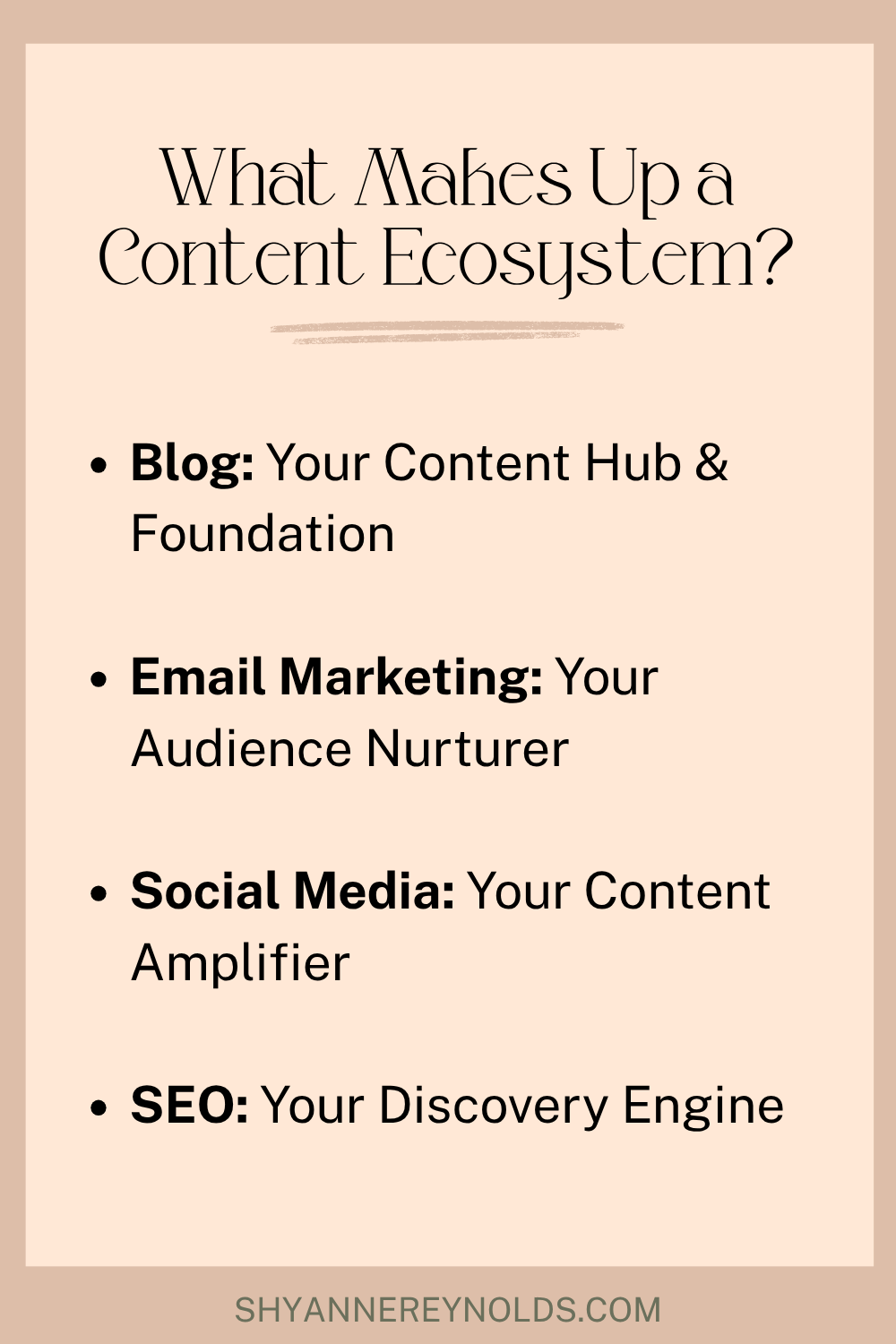
A strong content ecosystem is typically built on four key components: your blog, your email list, social media, and SEO. Each one serves a distinct purpose, and when they work together, they create a system that attracts, nurtures, and converts your audience on autopilot.
Here are the content types that a robust content ecosystem includes:
1. Your Content Hub: The Blog
Your blog is the foundation of your content ecosystem. It's where long-form, SEO-optimized content lives. This type of content is what gets discovered on Google, driving organic traffic and answering your audience's most pressing questions. Effective blog content helps build your audience, improves trust, and boosts both your domain authority and reputation over time.
Your blog serves as the starting point for every other piece of content, giving each platform something to link back to. Link to it in emails, tease it in social posts, and build your SEO strategy around it.
For food bloggers and health professionals, especially, a well-optimized blog is one of your most valuable long-term assets. A single post can drive consistent traffic for months or even years after it's published, which is something no Instagram post or email can replicate on its own!
2. Email Marketing: The Nurturer
If your blog is what gets people to find you, your email list is what gets them to trust you. Email marketing is the nurturing engine of your content ecosystem. By turning blog readers into email subscribers, you can move a random reader who stumbled across your blog into a warmer audience, bringing them closer to buying.
Unlike social media, your email list is an audience you actually own. The algorithm can't hide your content from them. In addition, because subscribers have already opted in, they're far more likely to engage, click, and eventually purchase than a cold social media follower.
A strong email strategy inside your ecosystem typically includes a welcome sequence that introduces new subscribers to who you are and what you offer, regular newsletters that connect back to your blog content, and nurture emails that build trust over time.
The goal isn't to sell in every email. It's to show up consistently so that when you do mention an offer, your audience is already warm and willing to buy.
3. Social Media: The Amplifier
Social media has its place in a content ecosystem, but it's important to understand what that place actually is. Social media is the amplifier, not the foundation, which is what many creators get wrong.
Its job is to pull new eyes into your ecosystem, not to be the destination itself. An Instagram post that teases your latest blog post, a quick tip that leads followers to your email opt-in, a behind-the-scenes reel that builds personality and trust... These are all ways social media feeds your ecosystem without carrying the full weight of your strategy.
This is a crucial distinction for food bloggers and health professionals who have been pouring energy into social media and wondering why it isn't converting. Social media is a fantastic top-of-funnel tool, but it works best when it's directing people toward your blog and email list, where the real nurturing and converting happens.
4. SEO: The Connective Tissue
SEO is what makes your entire content ecosystem discoverable and self-reinforcing over time. It not only helps your blog posts and website rank on Google, but it also ensures that the right people find the right content at the right moment.
When implemented correctly, a well-rounded SEO strategy keeps people in your content ecosystem and turns them into loyal fans.
A strong SEO strategy inside your ecosystem includes keyword research that shapes every blog post you create, search-intent-driven content that answers exactly what your audience is already looking for, and link building that connects your posts to each other and keeps readers exploring your site longer.
When SEO is woven into your content ecosystem from the start, your blog posts start to compound, delivering incredible bang for your buck. Each new post strengthens the ones around it, building authority over time and creating a web of content that keeps working long after you've hit publish.
How to Build a Content Ecosystem (Step-by-Step)
Okay, now that you know what a content ecosystem is and why it's important, it's time to map out a robust content ecosystem that drives search engine traffic and helps you reach your business goals.
Step 1: Define Your Content Pillars
Before you create a single piece of content, you need to know what your ecosystem is built around. Content pillars are the 3-4 core topics that anchor everything you create from your blog posts to your emails, your social content, and everything else.
Your content pillars should include topics that provide answers for what your audience is actively searching for while linking back to your offers. For a food blogger, that might look like easy weeknight dinners, meal prep, and budget-friendly recipes. For a health professional, it might be gut health, hormone balance, and nutrition basics.
Start by brainstorming what your clients or audience are constantly asking you. Then, Google related topics, and start building a list! You'll never have to wonder what to write or post about next.
Step 2: Build Your Content Hub First
Once you know your pillars, your first priority is building out your blog. Before you worry about growing your Instagram following or perfecting your email strategy, focus on creating long-form, SEO-optimized blog content that can be found on Google.
Every day, people are typing questions into Google about recipes, workouts, nutrition tips, and health advice, meaning your ideal audience is actively searching for the content you should be putting out. A well-optimized blog post puts you directly in front of those people at the exact moment they're looking for help.
Unlike social media posts that disappear in 48 hours, blog content is evergreen. A post you publish today can drive consistent organic traffic six months, a year, or even three years from now. Plus, when you provide genuinely helpful content, you're positioning yourself as an authority, building more trust than a 30-second social media post ever could.
Step 3: Build Your Email Flow
Once your blog is up and running and driving traffic, the next step is making sure that traffic has somewhere to go. That's where your email flow comes in.
Your email flow is the pipeline that takes someone from first-time blog reader to engaged subscriber to warm buyer. It typically starts with an opt-in incentive, like a freebie, a resource, or a simple newsletter sign-up, that gives visitors a reason to hand over their email address before they leave your site.
From there, a welcome sequence introduces new subscribers to who you are, what you do, and how you can help them. This is one of the most important pieces of your ecosystem, because it sets the tone for the entire relationship, priming your audience to actually engage with your emails. According to Campaign Monitor, 70% of email subscribers expect a welcome email when they subscribe!
After the welcome sequence, regular newsletters keep that relationship warm, giving insight into your personality and brand, driving readers back to your blog, and later serving to promote different campaigns and offers. The goal is to keep your subscribers moving through your ecosystem rather than letting them go cold.
Step 4: Repurpose Across Channels
One of the biggest misconceptions about building a content ecosystem is that it requires creating brand-new content for every single platform. It doesn't. In fact, one of the greatest advantages of a well-built ecosystem is how far a single piece of content can stretch.
Here's a simple example of what that looks like in practice:
You publish a new blog post about meal prepping for the week.
That post becomes your next email newsletter.
Three key tips from the post become three separate Instagram captions.
A summary graphic becomes a Pinterest pin.
One blog post just fueled an entire week's worth of content across every channel without you starting from scratch once.
This is called content repurposing, and it's one of the most efficient ways to keep your ecosystem active and consistent without burning out. The blog post is always the starting point. Everything else flows from it.
Step 5: Use Internal Linking to Connect It All
The final piece of building a strong content ecosystem is one that often gets overlooked: internal linking. Internal links are links within your blog posts that point to other relevant posts or pages on your own website. They do two very important things:
First, internal links keep readers inside your ecosystem longer. When someone finishes reading one of your blog posts and sees a link to another relevant post, they click it. And then maybe another. The longer someone spends on your site, the more trust you build and the more likely they are to opt into your email list or explore your offers.
Second, internal links signal authority to Google. When your posts link to each other, Google can better understand the relationship between your content and how knowledgeable you are on a given topic. Over time, a strong internal linking strategy helps your entire blog rank better, not just individual posts.
A good rule of thumb is to include at least two to three internal links in every blog post you publish, pointing to content that's genuinely relevant and helpful for the reader.
How to Know If Your Content Ecosystem Is Working
Building a content ecosystem takes time, and the results don't always show up overnight. For instance, I always tell clients that SEO takes roughly 6-12 months before we can measure results. However, once your system is up and running, there are clear signs that tell you whether it's working the way it should or whether something needs attention.
Signs Your Content Ecosystem Is Healthy
Your traffic is compounding, not plateauing. Rather than spiking after a new post and dropping off immediately, your overall blog traffic trends upward over time. Older posts are still bringing in visitors. New posts build on the authority of existing ones. Growth feels steady and self-sustaining rather than dependent on your posting frequency.
Your email list is growing consistently. New subscribers are coming in regularly without you running paid ads or constant promotions. This tells you that your blog content is attracting the right audience and your opt-in is compelling enough to convert readers into subscribers.
Your content is converting without paid ads. People are finding your offers, booking calls, or purchasing products through organic traffic and email alone. You're not relying on a launch or an ad spend every time you want to generate revenue. Your ecosystem is doing the selling for you.
Your audience engages across multiple touchpoints. Subscribers are opening your emails, clicking through to your blog, and following you on social. This is a sign that your content is connected, and your audience is moving through your ecosystem the way you intended.
Signs Your Content Ecosystem Needs Work
You have a high bounce rate. Visitors are landing on your blog and leaving without clicking anywhere else. This usually means your internal linking needs attention, your content isn't matching what readers were searching for, or your opt-in isn't compelling enough to give them a reason to stay.
Your email click-through rates are low. Subscribers are opening your emails but not clicking through to your blog or your offers. This is often a sign that your emails aren't connected tightly enough to your content or that your calls to action need to be clearer and more intentional.
Your content doesn't connect to your offers. You're publishing regularly, but none of it naturally leads readers toward what you sell. If someone could read your blog for a month and still have no idea what you offer or how to work with you, your ecosystem has a gap that needs to be filled.
Your growth feels inconsistent and exhausting. If every spike in traffic or revenue is tied to a specific launch, a viral post, or a burst of activity on your part, your ecosystem isn't compounding yet. Sustainable growth should feel like it's building on itself, not starting over every time you slow down.
Common Content Ecosystem Mistakes to Avoid
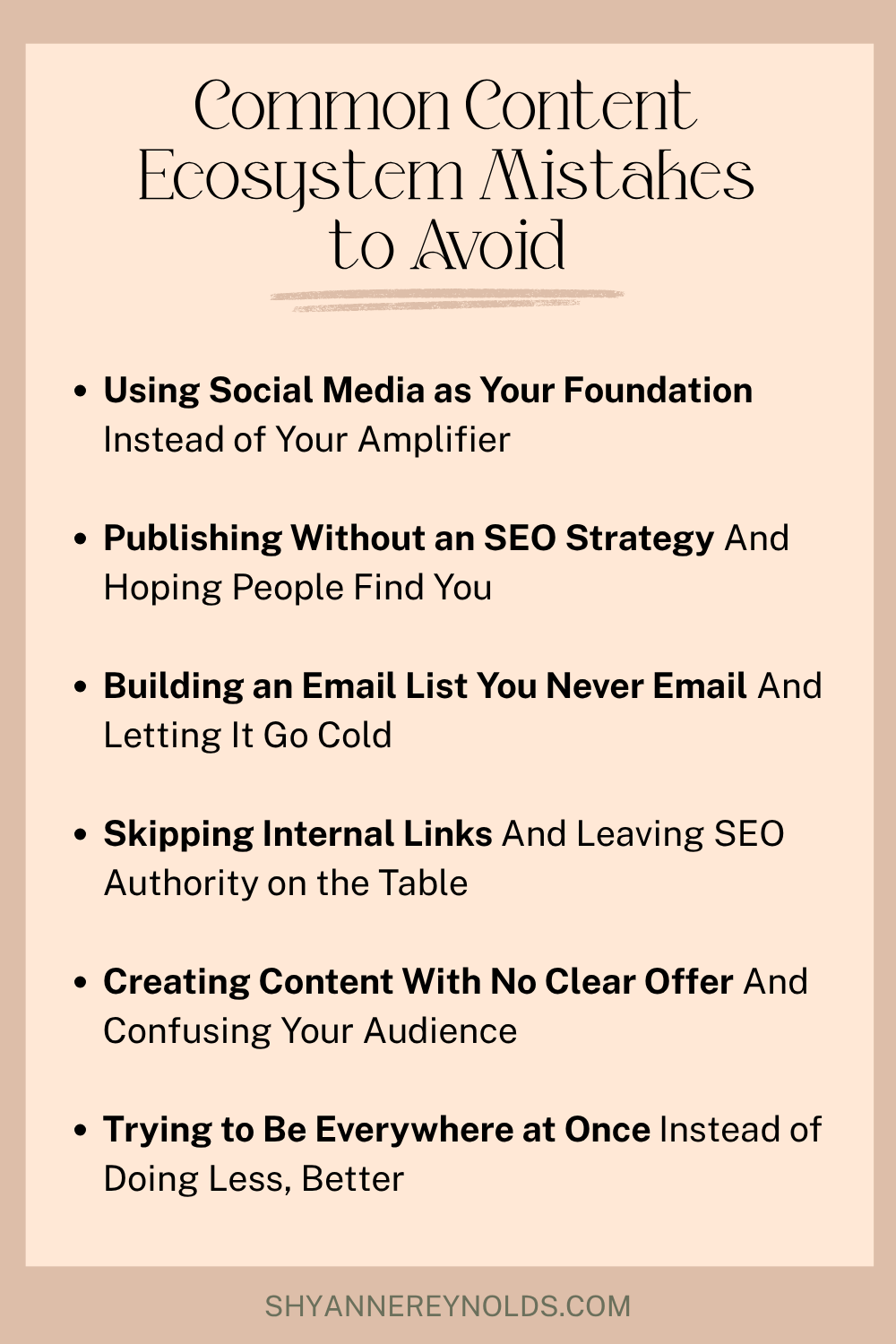
Building a content ecosystem is one of the best investments you can make in your business, but only if it's built strategically. Here are the most common mistakes that keep food bloggers and health professionals stuck on the content hamster wheel instead of seeing real, compounding growth.
Treating Social Media as Your Foundation
Social media is the amplifier, not the hub. When you build your entire content strategy around Instagram or TikTok, you're building on borrowed land.
Algorithms change, reach drops, and an audience you spent years growing can disappear overnight. Use social to drive people into your ecosystem, not as a substitute for one.
Creating Content Without an SEO Strategy
Publishing blog posts without keyword research is like opening a storefront in the middle of nowhere and hoping people wander in. SEO is what makes your content discoverable. Without it, even your best work sits unread.
Before you write a single post, make sure you know what your audience is actually searching for and that your content is optimized to show up when they search for it.
Building an Email List You Never Email
Growing an email list and then going silent is one of the most common mistakes I see creators make. Your subscribers signed up because they wanted to hear from you.
The longer you wait, the colder they get, and the more likely your emails are to go to spam. Consistency is what turns a list of names into a warm, engaged audience that actually buys. Even a simple weekly or biweekly email goes a long way toward keeping that relationship alive.
Ignoring Internal Linking
Internal linking is one of the easiest wins in content marketing and one of the most overlooked. If your blog posts aren't linking to each other, you're leaving both traffic and SEO authority on the table.
Every post you publish is an opportunity to keep readers on your site longer and signal to Google that you're an authority on your topic. Make it a habit to link to at least 3 posts for every new blog.
Trying to Be Everywhere at Once
More platforms do not mean more growth. Spreading yourself thin across every social media channel, podcast, YouTube, Pinterest, and blog at once is a fast track to burnout and mediocre content everywhere.
Start with one content hub, one email list, and one social platform. Do those well before you expand. A focused ecosystem that runs smoothly will always outperform a sprawling one held together with duct tape. Trust me. I learned the hard way.
In Conclusion
Creating a content ecosystem is the easiest way to eliminate burnout, create consistently, and grow your audience while boosting sales and conversions. SEO and blogging serve as the foundation of your digital content, driving organic traffic and spurring content creation in a broader context.
Each blog post should work to serve your audience, answering their most pressing questions. Then, an email list feeds back to your blog, and socials drive to both, while working to get new eyes on your content.
If you're a food blogger, health professional, or fitness expert ready to build your content ecosystem, I'd love to help. Explore my blog writing offers, explore my email writing offers, or get in touch to find out how we can build your content ecosystem together!
More Helpful Resources

Hi! I’m Shyanne.
I’ve been a content writer for 8 years now. I fell into this filed by accident after applying to a VA position from a nutritionist while in college.
Fast forward a few years later, and I had an English degree with a concentration in Creative Writing and minors in History and Nutrition, and a fledgling business.
Now, I help food bloggers, fitness experts, and health professionals with done-for-you blog writing and done-for-you email writing services!
Growing up, I always loved food and cooking, and writing was my first passion. Later, I discovered fitness and nutrition, and pursued personal training before really leaning into my writing career. Now, getting to marry all of my passions while helping others achieve their own goals truly feels like a dream.
I love all aspects of writing and am trained in SEO and copywriting. If you’re interested in hiring a content writer to handle your needs, I promise you’ll be in good hands!

Hey there — I’m Shyanne
Your new go-to SEO specialist and content writer for all things blogging and email.
If you’re a food blogger, fitness expert, or health professional who landed on this page, chances are you’re crazy good at what you do. But copy? SEO?
Not your thing.
Through research-backed SEO, content mapping, and human-driven copy, I help creators and entrepreneurs drive traffic to their brand and build deeper connections to foster community and boost sales — without the need to show up on socials every damn day.
If you’re ready to take your copy strategy to the next level, I’m ready to help!