What Are Long-Tail Keywords? (& How to Find Them)
Long-tail keywords are precise keyword phrases, often three words or more, that internet users look for using search engine queries. Most long-tail keywords have a smaller search volume than short-tail keywords, meaning they often generate fewer views but ultimately lead to better view time and click-through rates due to a better match in search intent.
When writing blog posts for myself and clients, I use a combination of short and long-tail keywords in order to reach a broader audience and give better context to search engines (and readers).

Long-Tail vs. Mid-Tail vs. Short-Tail Keywords
Not all keywords are created equal. They generally fall into three categories based on length, search volume, and competition.
Short-tail keywords are, as the name suggests, short words, typically one to two words that cover a broad topic. They generally have the highest search volume and highest competition.
Short-tail keyword example: protein bars.
Mid-tail keywords are somewhere in between long and short-tail keywords. They have a little more specificity than short-tail but aren’t hyper-specific. As a result, they fall in the mid range of both search volume and difficulty.
Mid-tail keyword example: no-bake protein bars.
Admittedly, the line between mid-tail and long-tail keywords is blurry. There’s not much difference, and they can be categorized as one or the other by just a word or two. Don’t stress the difference. It’s just important to know it exists.
Long-tail keyword example: protein bars without peanut butter.

A Google search for a long-tail keyword “homemade protein bars without peanut butter.
How Exactly Do Long-Tail Keywords Work?
Infusing long-tail keywords into your blog posts helps Google and AI engines understand what your post is about. Google’s goal is to deliver the most relevant result for every user search. Therefore, the more specific a search query becomes through long-tail keywords, the easier it is for Google to understand what a user wants.
For example, someone searching for “chicken” could be looking for recipes, nutrition information, or even how to buy a chicken. That search is likely to deliver a large array of results.
However, someone searching “healthy grilled chicken marinade without soy sauce” has a very specific goal, and they’ll get a very specific outcome.
If you infuse the long-tail keyword in your copy, chances are that the person looking for a chicken marinade will stumble upon your page.
Another important point is that Google understands related searches.
A single article optimized for one long-tail keyword often ranks for dozens or even hundreds of similar keyword variations, meaning your post instantly becomes a lot more discoverable.
For example, a post targeting: healthy blueberry oatmeal muffins with yogurt
might also rank for:
blueberry yogurt muffins
healthy oatmeal blueberry muffins
Greek yogurt blueberry muffins
blueberry muffins with oats
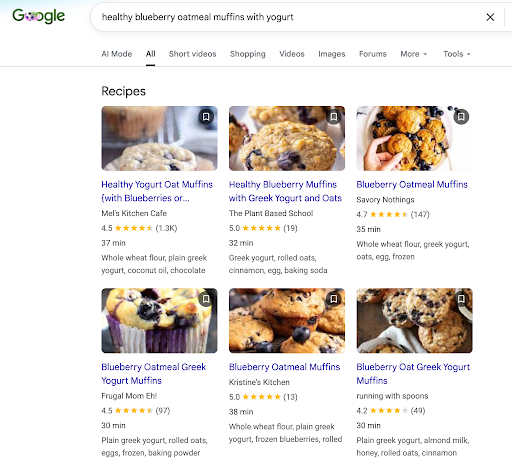
A Google search result for a long-tail keyword “healthy blueberry oatmeal muffins with yogurt.
How to Find Long-Tail Keywords
I use SEMrush to search for all of my keywords, but any keyword research tool will work. Try experimenting with Keysearch, Ahrefs, Google’s autocomplete predictions, analyzing Google’s People Also Ask boxes, looking at competitors’ rankings, or looking at your own blog post rankings.
1. Use Keyword Research Tools
Start by searching for a short-tail keyword in your research tool of choice. Then, look at the results to see if there are any long-tail keywords that fit your goal.
For example, if you search for chocolate chip cookies, that’s likely going to be way too difficult to rank for. But you might be able to rank for “browned butter chocolate chip cookie recipe.”
Look for keywords with moderate to low competition, clear search intent, reasonable monthly search volume, and relevance to your audience.
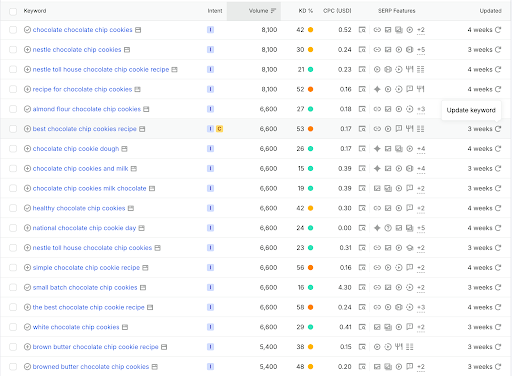
Search for a term in a keyword research tool to find relevant long-tail keywords.
2. Look at Google's "People Also Ask"
The "People Also Ask" box is full of questions people are actively searching. Google a term related to your blog, and see what people are asking. Each question can become an FAQ or even an entire blog post.
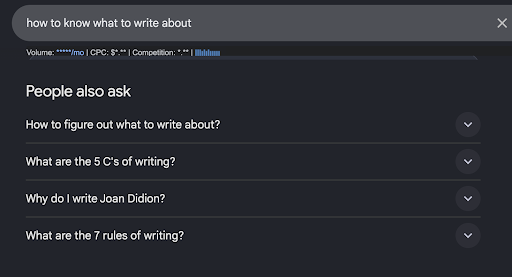
Google your keyword of choice, and scroll down to People Also Ask to find relevant queries and additional terms.
3. Check Related Searches
Scroll to the bottom of Google's search results to find additional keyword ideas. These related searches often reveal valuable long-tail variations.

Google a keyword, and scroll to the bottom of the page to find relevant related searches.
4. Study Your Competitors
Find websites that rank well in your niche and examine the topics they're covering. Are there any that are relevant to your own audience? Often, you'll discover keyword variations or content gaps you can target with your own articles. Of course, never plagiarize, but it’s a good way to draw inspiration!
5. Listen to Your Audience
Some of the best long-tail keywords come directly from your readers. Look for recurring questions in blog comments, social media posts, Reddit, Facebook groups, and email inboxes. If people keep asking the same question, there's a good chance others are searching for it, too.
What Are Long-Tail Keywords FAQs
-
A long-tail keyword is a specific, multi-word search phrase, such as "protein bars without peanut butter" or "browned butter chocolate chip cookie recipe." Instead of just "cookies" or "protein bars," it nails down exactly what the searcher wants, which makes it both easier to rank for and more likely to convert once someone lands on your page.
-
Keywords are usually grouped by two different lenses: length and intent.
By length, you've got short-tail (1-2 words, broad, high competition: Think: "protein bars"), mid-tail (a bit more specific, like "no-bake protein bars"), and long-tail (3+ words, hyper-specific, like "protein bars without peanut butter").
By intent, keywords typically fall into four buckets: informational (someone wants to learn something, like "how to store protein bars"), navigational (someone's looking for a specific site or brand), commercial (someone's comparing options before buying, like "best protein bars for weight loss"), and transactional (someone's ready to buy, like "buy protein bars online").
Most blog content lives in informational and commercial territory, since that's where you can build trust before the sale happens.
-
A few examples of keywords across the spectrum include "chicken" (short-tail), "grilled chicken marinade" (mid-tail), and "healthy grilled chicken marinade without soy sauce" (long-tail). Any group of words used in search queries can be considered a keyword.
What Are Long-Tail Keywords? Next Steps
In short, long-tail keywords are search terms that are typically three or more words in length. They are useful to include in blog posts to alert Google to specific search intent and rank higher on Google. While the search volume of long-tail keywords is lower than short-tail keywords, they often deliver better results due to lower ranking difficulty and more optimized searches.
In your next blog post, work to incorporate both short and long-tail keywords (at least one of each) into your copy. No time? Check out my blog writing services to see how I can do this for you, or reach out with any questions. I’d love to help you rank on search engines and reach your ideal audience!
More Helpful Resources

Hi! I’m Shyanne, the blog writer behind Shyanne Reynolds Copywriting.
I fuse SEO strategy and personality to create human-driven copy that ranks without sounding like a robot.
Curious about working with me?