What are Short-Tail Keywords (& How to Find Them)
Short-tail keywords are words or short phrases that internet users use to find results in search engines. Typically consisting of one to three words, short-tail keywords are broad, generic terms that cover an entire topic.
Also called head terms or seed keywords, short-tail keywords often have a high search volume and are competitive. I use them as the primary keyword when writing blog posts for myself and clients and use them to lead to long-tail keywords in order to focus a post and help it show up on Google search and AI Overviews.

Examples of Short-Tail Keywords
As mentioned, short-tail keywords typically consist of one to three words, whereas long-tail keywords consist of three or more words describing the short-tail keyword.
Examples of long-tail and short-tail keywords include:
"chicken recipes" (short-tail) vs. "high-protein chicken recipes for meal prep" (long-tail)
"content strategy" (short-tail) vs. "content strategy for freelance writers with small budgets" (long-tail)
"pottery" (short-tail) vs. "beginner pottery classes near Eagle Mountain, Utah" (long-tail)
Notice how the short-tail version is broad enough to cover an entire category, while the long-tail version narrows in on a specific need, audience, or intent. Using both helps search engines better understand your content and match it to the right search intent in the search results. As a result, you're more likely to attract qualified visitors, improve conversions, and build trust with your audience.
When writing for clients, I focus on finding keywords that are related to the topic at hand rather than just looking for the biggest search volume potential. Ranking highly for a keyword that doesn't match search intent will do more harm than ranking highly for a less searched term that matches the search intent.
For example, if searching for breakfast burrito, a user might want to find a breakfast burrito from a restaurant. However, if searching for breakfast burrito recipe, you know they want a recipe. Therefore, by targeting that term instead of just "breakfast burrito," you'll be able to provide the results they actually want.
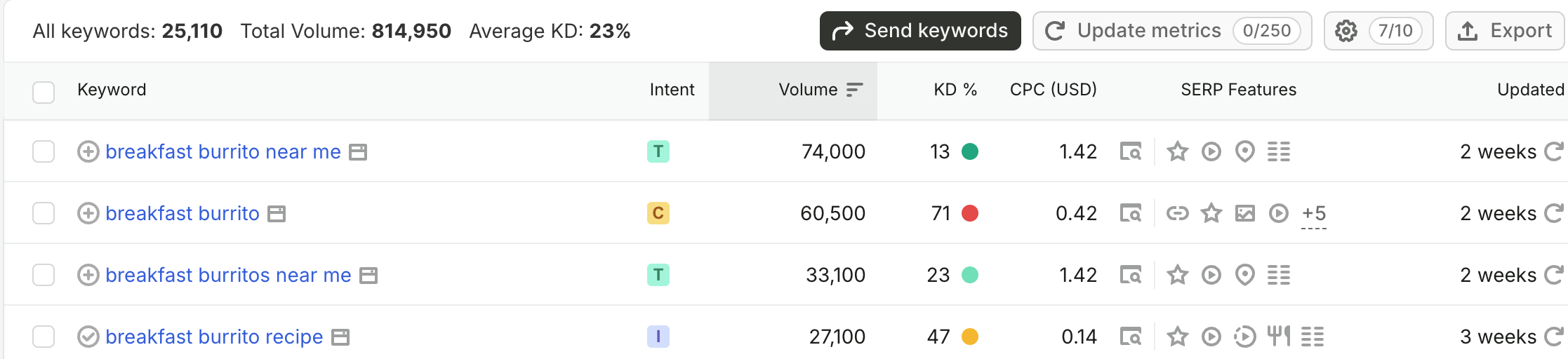
The search term “breakfast burrito” has a much higher search volume than “breakfast burrito recipe,” but “breakfast burrito recipe” is a better primary keyword to target for a recipe blog post to match the search intent.
Why Are Short-Tail Keywords So Important?
Short-tail keywords can be used to cover broad topics that have high search volumes. As a result, they’re useful in driving blog traffic, boosting views, and building domain authority.
However, because short-tail keywords are typically competitive, they can be difficult to rank for. In addition, their broadness may attract readers not explicitly interested in your content. This mismatch in user intent or interest can lead to higher bounce rates and lower engagement.
That’s why it’s important to utilize long-tail keywords, too. Together, they signal to search engines and users what a post is about, leading to higher rankings and better quality clicks.
How to Find Short-Tail Keywords
Finding the right short-tail keyword for a post starts with identifying the core topic you want to write about, then validating that topic with data. Here's how I approach it:
Start with your niche's core topics. Think about the 5-10 broad subjects your brand should own. For a food blogger, that might be "meal prep," "air fryer recipes," or "gluten-free baking."
Run those topics through a keyword tool. Tools like Semrush, Ahrefs, or even Google's Keyword Planner will show you search volume and competition level for each short-tail term, plus related keyword suggestions.
Check the SERP. Search the term yourself and see what's currently ranking. This tells you what kind of content (and how much authority) it takes to compete.
Look at "People Also Ask" and related searches. These often reveal the long-tail variations and subtopics you'll want to build supporting content around.
Confirm it fits your topical authority. A short-tail keyword is only worth targeting if it aligns with the broader topic cluster you're building on your site. Otherwise, you're chasing traffic that doesn't support your overall strategy.
Once you've chosen your short-tail keyword, use it to anchor your post, then build out supporting long-tail keywords to cover related searches and strengthen your topical relevance.
Short-Tail Keywords FAQs
-
For the best SEO strategy, you should target both long-tail keywords and short-tail keywords. Short-tail keywords help you cover a broad topic and signal what your post is about, while long-tail keywords let you narrow in on a specific search intent and compete for less crowded terms.
I use short-tail keywords as the anchor for a post, then build supporting long-tail keywords around it to strengthen topical relevance and improve the odds of ranking.
-
Keywords are generally grouped by length and by intent. By length, you have short-tail (head) keywords and long-tail keywords. By intent, keywords typically fall into four categories:
Informational: The searcher wants to learn something (e.g., "how to make sourdough starter")
Navigational: The searcher is looking for a specific site or brand (e.g., "Averie Cooks blog")
Commercial: The searcher is researching before a purchase (e.g., "best stand mixer for bread dough")
Transactional: The searcher is ready to buy or take action (e.g., "buy KitchenAid stand mixer")
Understanding both the length and the intent behind a keyword helps you match your content to what the searcher actually wants, which ties directly back to search intent.
-
Contrary to popular belief, SEO is not dead, but it is evolving. Google is still handling billions of searches a day, but AI Overviews and zero-click results have changed what "ranking" actually gets you.
That said, search rank remains one of the strongest factors in whether AI systems cite a page at all, since these tools pull their answers from content that's already ranking well. One large-scale study found organic traffic declined only modestly year over year in 2025, nowhere near the dramatic drop-offs often cited online.
What's actually dying is thin, generic, keyword-stuffed content. What's winning is the opposite: original, experience-backed writing with genuine topical authority, which is exactly why choosing the right short-tail keyword to anchor a topic, then building it out with long-tail support, matters more now than ever.
Short-Tail Keywords Recap
Short-tail keywords are the broad, one-to-three-word terms that anchor a blog post and tell search engines (and readers) what it's about. They're high-volume and high-competition, which makes them powerful for visibility but risky to rely on alone.
The best SEO strategy is to use both long-tail and short-tail keywords in your blogs. Lead with a short-tail keyword to establish your topic, then support it with long-tail keywords to narrow in on search intent, reduce bounce rate, and give search engines and AI Overviews a clearer signal of exactly who your content is for.
Get this pairing right, and you'll have a post built to rank and built to keep the readers it attracts. Be sure to check out my SEO checklist to improve your blog rankings, too! Or, check out my blog writing services to see how I can do all of this for you.
More Helpful Resources

Hi! I’m Shyanne, the blog writer behind Shyanne Reynolds Copywriting.
I fuse SEO strategy and personality to create human-driven copy that ranks without sounding like a robot.
Curious about working with me?

Hi! I’m Shyanne, the blog writer behind Shyanne Reynolds Copywriting.
I fuse SEO strategy and personality to create human-driven copy that ranks without sounding like a robot.
Curious about working with me?